Keratosis lichenoides chronica (syn. Nekam’s disease)
LAST UPDATED: Aug 08, 2021
Introduction
Keratosis lichenoides chronica (KLC) is a rare condition characterised by the asymptomatic development, over several years, of scaly papules on the limbs and trunk, sometimes distributed in a linear or reticulate (net-like) pattern.
This chapter is set out as follows:
History
-
There is no apparent sexual predisposition
-
The great majority of cases are adults between the ages of 20 and 40 years, although other age groups can be affected
-
The condition is usually not itchy
Clinical findings
Distribution
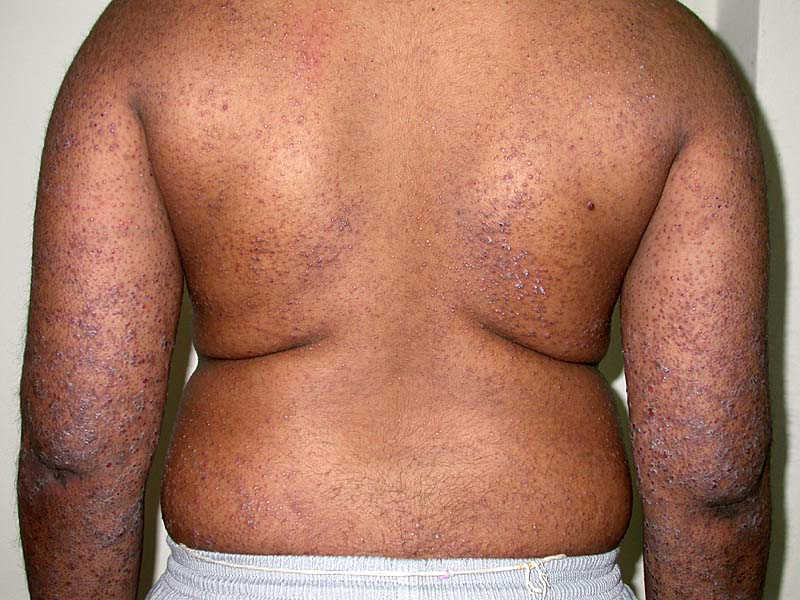
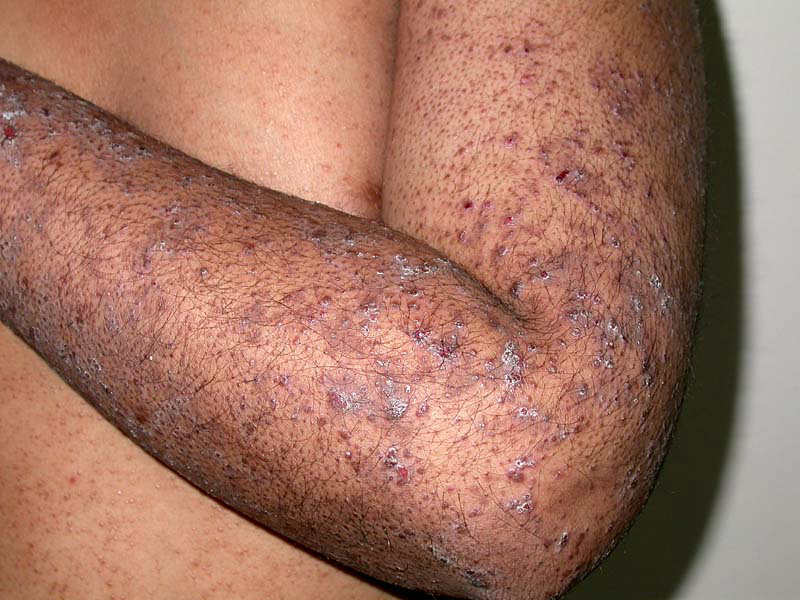
- A relatively symmetrical distribution on the limbs and buttocks, with a predilection for the dorsal surfaces of the thighs and forearms
- The trunk can be involved, and the lesions may become more generalised
Morphology
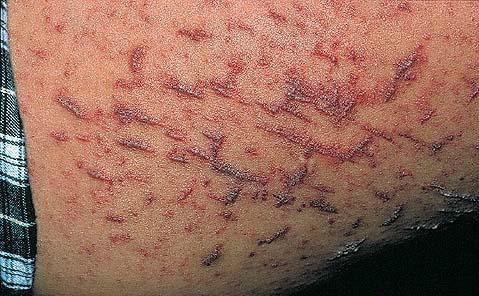
- Brown-purple, scaly papules and small nodules, often disposed in a linear or reticulate (net-like) pattern
- The papules of the trunk are classically thinner
Other mucocutaneous features
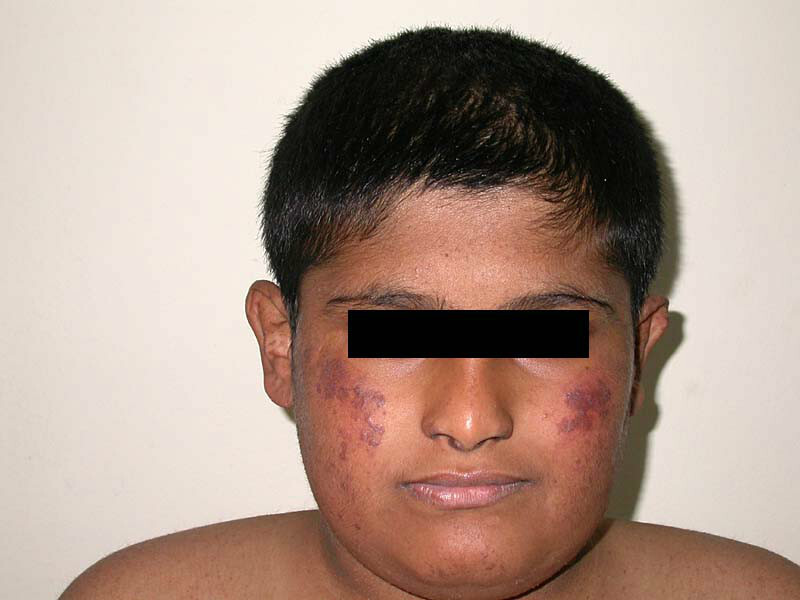
- In 75% of cases an erythematosquamous eruption on the mediofacial area is found, mimicking seborrhoeic eczema
- In 50% of cases the condition involves the oral or genital mucous membranes, presenting as ulcerations, infiltration or inflammation. Occasionally there may be ocular involvement
- In 30% of cases there is nail involvement with thickening, longitudinal ridging, and sometimes paronychia
- Palmoplantar keratoderma has occasionally been reported
Clinical Images
Please refer to notes on image rights at bottom of the page with regards to individual image
ownership.
Investigations
-
Histologically, the local parakeratotic hyperkeratosis forms some intra-epidermal keratotic plugs, which can sometimes be bulky. The layer of Malpighi is often atrophic. The basal layer is often widely liquefied, with the presence of many colloid bodies. The upper dermis is occupied by a band-like lymphohistiocytic infiltrate, with distinct lower limits. Mononuclear cells may migrate into the epidermis (reference: Rook's Textbook of Dermatology)
-
The histology mimics verrucous lichen planus, which is the main differential diagnosis. However, in keratosis lichenoides chronica lesional pattern and distribution are different and pruritus is usually absent
Management
Treatment
-
A review of the literature shows that the treatment of keratosis lichenoides chronica is difficult
-
Topical therapies are generally ineffective, however, topical calcipotriol has been reported as beneficial
-
Systemic steroids, and immunosupressive therapies are ineffective
-
Among the other treatments tested, several observations reported partial or complete improvement with oral retinoids, PUVA phototherapy or a combination of the two
Prognosis
-
The course is chronic and progressive, extending over many years
-
Some elements may disappear spontaneously, leaving no scar or leaving residual pigmented atrophy
-
Exceptionally, complete spontaneous remissions may be observed
Disclaimer - the author PCDS cannot accept responsibility for any misleading or incorrect statements, and the management of individual patients remains the direct responsibility of the individual doctor. We do however hope that visitors to this site can contact us regarding comments that are considered misleading or incorrect so that we can continue to improve the site.
Image Rights - The PCDS would like to thank Dermatoweb, DermQuest (Galderma), and others who have contributed images. All named individuals and organisations maintain copyright for the relevant images.