Orofacial granulomatosis (including granulomatous cheilitis)

LAST UPDATED: Oct 04, 2024
Introduction

Orofacial granulomatosis is a rare chronic inflammatory condition characterised by lip swelling, a histological finding of non-caseating granulomas in mucosal or skin biopsies taken from the mouth or face, and the absence of a recognised systemic condition known to cause granulomas such as Crohn’s disease, sarcoidosis, and granulomatosis with polyangiitis.

This chapter is set out as follows:


Aetiology

  • Orofacial granulomatosis (OFG) affects males and females equally, and can arise at any age
  • In many causes the cause is unknown although some patients appear to have food sensitivities, especially to cinnamon, benzoates, and chocolate
  • It is believed the granulomas block the lymphatic vessels resulting in lymphoedema

History

  • The initial swelling is painless 

Clinical findings

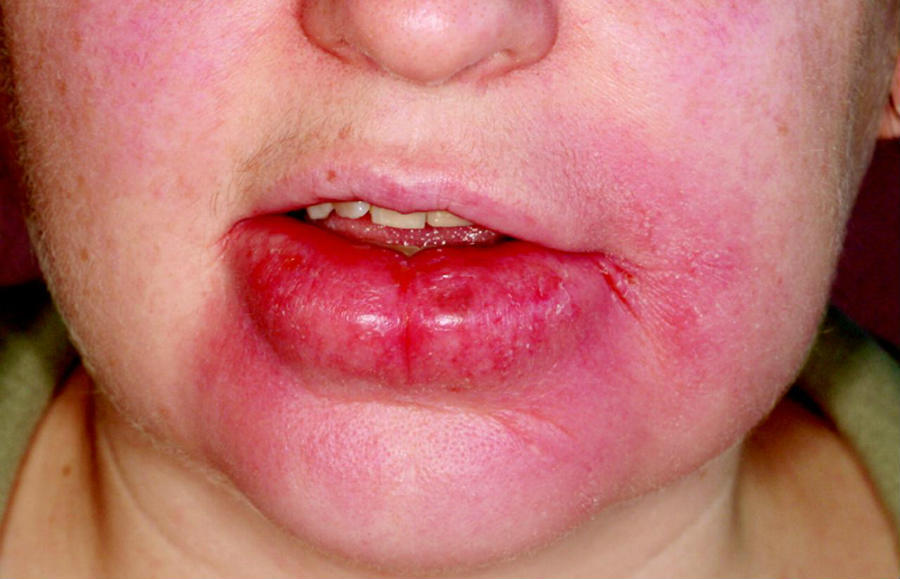
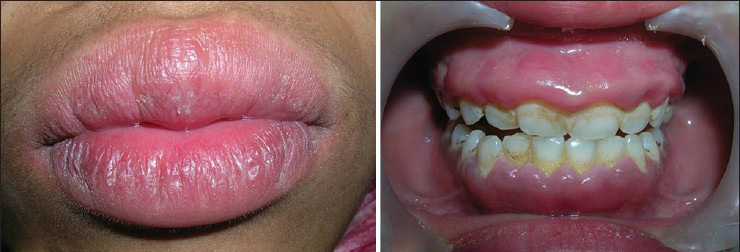
  • The earliest manifestation of orofacial granulomatosis is sudden, diffuse or occasionally nodular swellings of the lip or the face involving (in decreasing order of frequency) the upper lip, the lower lip, and one or both cheeks. The forehead, the eyelids, or one side of the scalp may be involved (less common). Lip involvement alone is sometimes referred to as granulomatous cheilitis
  • Initially the swelling is soft and intermittent, with each episode lasting weeks or months. Eventually the lip enlargement becomes permanent and the lip feels firm or rubbery; painful fissures may develop 
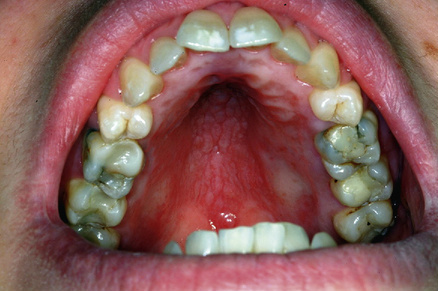
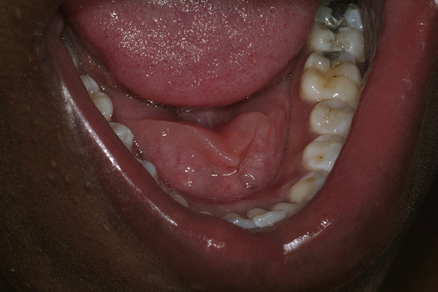
  • Swelling may also affect the mouth to produce a cobblestone appearance on the buccal mucosa and inside the lips, and enlargement of the gums or tongue
  • Other findings can include mucosal tags and mouth ulcers; a fissured tongue is seen in 20-40% of patients
  • In the Melkersson-Rosenthal syndrome there is associated facial nerve paralysis

Clinical Images

Please refer to notes on image rights at bottom of the page with regards to individual image ownership.

Investigations

  • A deep incisional biopsy shows the presence of non-caseating granulomas in approximately 50% of cases. There are also dilated lymphatic's and blood vessels, oedema, and non-specific inflammation 
     
  • Further investigations, to exclude other causes of granulomas, may include:
    • Routine haematology and biochemistry
    • Crohn's disease - in addition to the above check inflammatory markers and faecal calprotectin  
    • CXR for sarcoid 
  • Patch tests may be used to check for allergies such as cinnamon and benzoates. They could also be considered to look for an alternative diagnosis of contact allergic dermatitis - in such cases there is often significant dryness/scaling of the lips, with a lesser degree of swelling 


Management

  • There is no curative treatment. Spontaneous remission can occur but is rare. Treatment is often difficult and unsatisfactory
  • Some patients benefit from a cinnamon- and benzoate-free diet (or any other identified substances) - such a diet should be trialled for three months, and can be continued if beneficial  
  • Topical or intralesional corticosteroids may be helpful in some patients
  • Various other treatments tried include topical tacrolimus, oral tetracycline's, and dapsone 
  • It is important to keep an open mind about the diagnosis; oral manifestations of Crohn’s disease have a prevalence ranging from 20-50% and may precede bowel symptoms 

Disclaimer - the author PCDS cannot accept responsibility for any misleading or incorrect statements, and the management of individual patients remains the direct responsibility of the individual doctor. We do however hope that visitors to this site can contact us regarding comments that are considered misleading or incorrect so that we can continue to improve the site.

Image Rights - The PCDS would like to thank Dermatoweb, DermQuest (Galderma), and others who have contributed images. All named individuals and organisations maintain copyright for the relevant images.

Quick Links

The following pharmaceutical companies have had no involvement in the content of this website or in our conference programmes

Almirall
Galderma
Glenmark
Johnson & Johnson
La Roche-Posay
LEO Pharma
Pierre Fabre
Schuco