Piebaldism

LAST UPDATED: Jul 29, 2021

Introduction

Piebaldism is a rare autosomal dominant disorder of melanocyte development characterised by a congenital white forelock and, usually, multiple symmetrical hypopigmented or depigmented macules.

This chapter is set out as follows:


Aetiology

  • Piebaldism is an autosomal dominant genetic disorder meaning 50% of an affected individuals children will also have the condition
  • It is caused by an absence of melanocytes in affected skin and hair follicles, which for most individuals occurs as a result of mutations in the KIT proto-oncogene

Clinical findings

  • The clinical features are completely developed at birth (or when hair colour first becomes apparent) and do not usually change thereafter
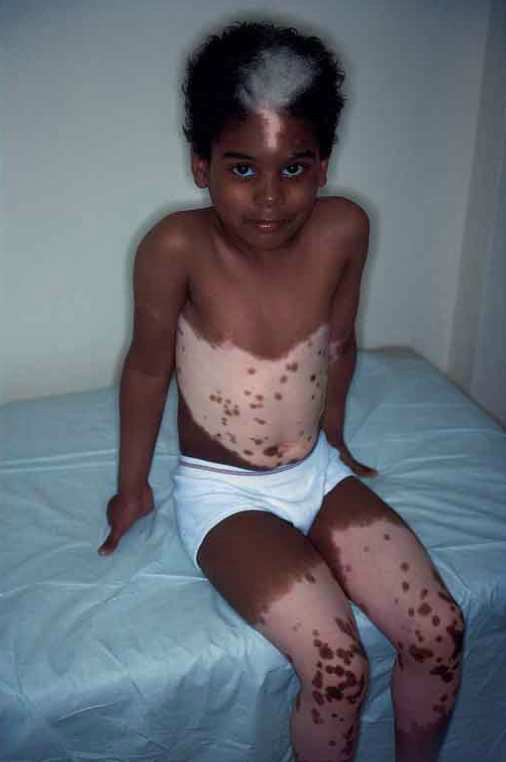
  • The white forelock (a lock of hair growing just above the forehead) is evident in 80-90% of those affected - the eyebrow and eyelash hair may also be affected, either continuously or discontinuously with the forelock. White patches of hair may be located other than frontally in some patients
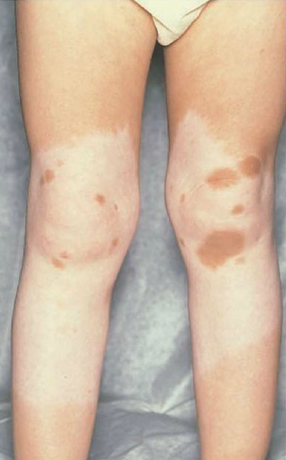
  • White patches of skin may also be seen, and tend to have the following characteristics:
    • Distribution - the face (particularly the chin), trunk and the distal limbs, although the hands and feet are usually spared
    • Morphology - lesions tend to be symmetrical in distribution and irregular in shape. Commonly, islands of normal or hyperpigmented skin are present within and at the border of the depigmented areas, giving the skin a spotted or thumbprint appearance
  • Piebaldism is one of the signs of the Waardenburg syndrome, along with heterochromia of the irides, lateral displacement of inner canthi, and deafness

Clinical Images

Please refer to notes on image rights at bottom of the page with regards to individual image ownership.

Management

  • There is no specific treatment
  • Patients are at an increased risk of UV damage and need to be given appropriate advice on UV protection
  • Offer referral to a camouflage team for best advice on how to cover up the affected areas. Camouflage teams tend to be based in hospital outpatient departments, if this is not so contact your local dermatology department or Changing Faces. Alternatively patients may wish to use their own fake tan products

Disclaimer - the author PCDS cannot accept responsibility for any misleading or incorrect statements, and the management of individual patients remains the direct responsibility of the individual doctor. We do however hope that visitors to this site can contact us regarding comments that are considered misleading or incorrect so that we can continue to improve the site.

Image Rights - The PCDS would like to thank Dermatoweb, DermQuest (Galderma), and others who have contributed images. All named individuals and organisations maintain copyright for the relevant images.

Quick Links

The following pharmaceutical companies have had no involvement in the content of this website or in our conference programmes


Almirall
Galderma
Glenmark
Johnson & Johnson
La Roche-Posay
LEO Pharma
Pierre Fabre
Schuco