Urticarial vasculitis and acquired autoinflammatory disorders
LAST UPDATED: Aug 02, 2021
Introduction
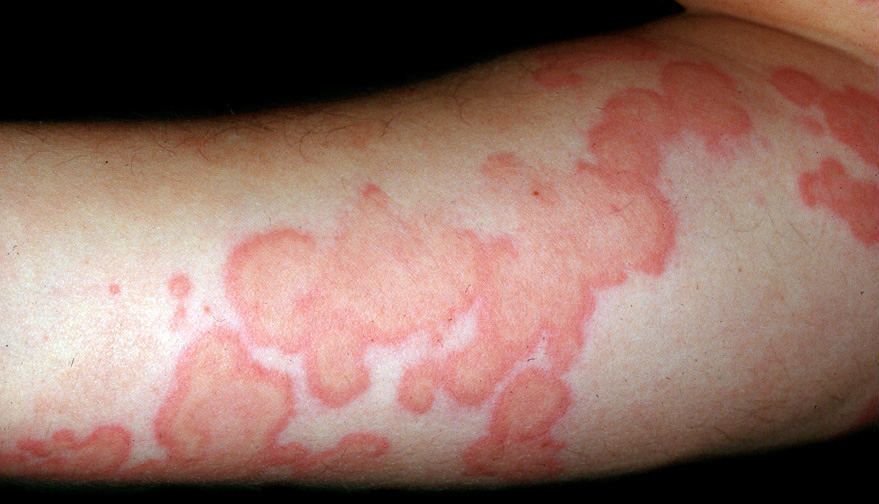
Urticarial vasculitis is an eruption of erythematous wheals that clinically resemble urticaria, but differ in that lesions persist for greater than 24 hours and some cases are associated with systemic features.
The acquired autoinflammatory conditions are a group of disorders where urticaria/rashes are associated with a variety of systemic symptoms including recurrent fever, arthralgia or arthritis, and fatigue.
This chapter is set out as follows:
History
Urticarial vasculitis
-
Classification
- Normocomplementaemic - normal levels of the complement proteins found on blood testing
- Hypocomplementaemic - reduced levels of complement proteins
-
History
- Lesions persist for more than 24 hours and can be painful or tender as opposed to itchy
- Although both types of urticarial vasculitis may be associated with systemic symptoms such as angioedema, abdominal or chest pain, fever, and joint pain, these are more apparent in the hypocomplementaemic form
-
Distribution
- The trunk and proximal limbs are the most commonly affected sites
-
Morphology
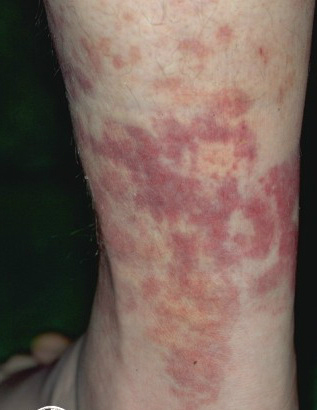
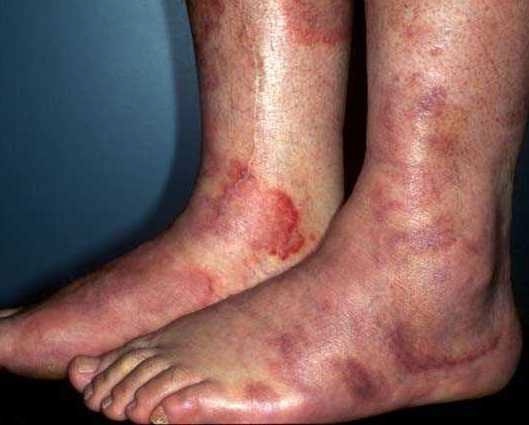
- Urticaria-like lesions persist longer than 24 hours, and often demonstrate purpuric foci and post-inflammatory hyperpigmentation
- Lesions are sometimes more angulated than those seen in classical urticaria
-
Investigations
- The most important blood tests are the complement C3 and C4 levels, if reduced the test should be repeated to confirm the findings
- Renal investigations - urinalysis, urine protein:creatinine ratio, U&E, BP (looking for renal involvement)
- Other blood tests - FBC, inflammatory markers and a biochemical profile
- Results of skin biopsies are not always helpful, and vary from showing minimal signs of vasculitis to much more obvious vasculitic change
-
Management
- Normocomplementaemic vasculitic urticaria - usually localised to the skin and runs a relatively benign course lasting about three years. First line treatment are non-sedating antihistamines
- Hypocomplementaemic vasculitic urticaria - usually associated with reduced C4 levels, only occasionally C3 levels. This condition is generally much more problematic as it often represents part of a broader immune problem eg C1q deficiency (with anti-C1q antibodies), lupus erythematosus, or hepatitis B/C - such patients require referral to Secondary Care. Treatments include systemic steroids, dapsone, colchicine and hydroxychloroquine
Autoinflammatory syndromes
-
Autoinflammatory syndromes are a rare group of conditions caused by an exaggerated innate immune system response resulting in episodes of spontaneous inflammation affecting multiple organs
-
They are often associated with a diagnostic delay of many years
-
This group of conditions includes Schnitzler's syndrome, systemic juvenile idiopathic arthritis (Still's disease) along with its adult form, and the cryopyrin-associated periodic syndromes (including the Muckle-Wells syndrome)
-
In addition to urticaria and other erythematous eruptions, patients suffer from a variety of systemic symptoms including recurrent fever, arthralgia or arthritis, and fatigue
-
Schnitzler's syndrome - arises in the context of a monoclonal paraproteinaemia, typically IgM and rarely IgG. The patients are usually adults of the age of 40–60 and develop a recurrent urticarial rash accompanied by systemic symptoms (fever, arthralgia, myalgia, lymphadenopathy and hepatosplenomegaly). Other tests usually show leucocytosis and elevated ESR/CRP levels
-
Patients suspected of having autoinflammatory conditions require referral to Secondary Care
Clinical Images
Please refer to notes on image rights at bottom of the page with regards to individual image
ownership.
Disclaimer - the author PCDS cannot accept responsibility for any misleading or incorrect statements, and the management of individual patients remains the direct responsibility of the individual doctor. We do however hope that visitors to this site can contact us regarding comments that are considered misleading or incorrect so that we can continue to improve the site.
Image Rights - The PCDS would like to thank Dermatoweb, DermQuest (Galderma), and others who have contributed images. All named individuals and organisations maintain copyright for the relevant images.