February 2015 | Case of the month - gain CPD points

History

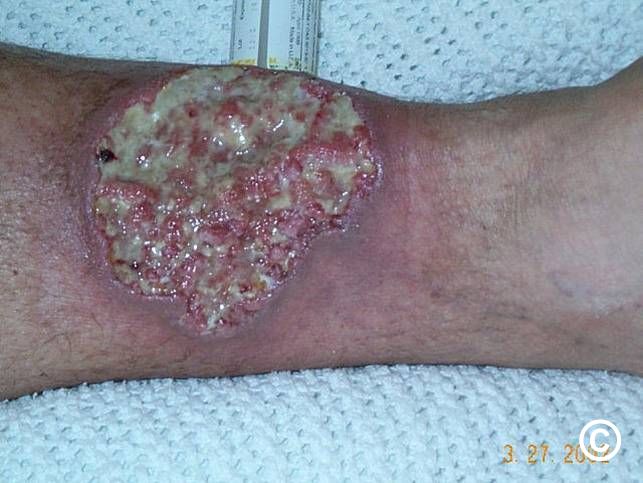
A 54 year old man was referred to clinic with an eight week history of a very painful ulcer on his left shin, which had increased in size very quickly. There had been no trauma, and he had not been started on any new medication. Of relevance he had a history of ulcerative colitis. 


Examination

Examination revealed a substantial ulcer with an irregular blue-purple border. 

Blood tests revealed raised inflammatory markers. 

Swabs showed a light growth of skin commensals.


Investigations

What is the diagnosis? 

Images

Diagnosis

RevealHide the answer

  • The diagnosis was consistent with Pyoderma gangrenosum (PG), a rare, neutrophilic dermatosis, commonly associated with systemic disease
     
  • Although there are a number of PG variants, the typical presentation is a painful ulcer (or ulcers) that grows rapidly and develops an irregular, undermined, blue-purple edge
     
  • 50-70% of cases have an underlying cause, approximately equally divided between three groups:
    • Inflammatory bowel disease (IBD), especially ulcerative colitis
    • Haematological conditions, especially myeloid leukaemia's. Also myelodysplasia and monoclonal gammopathy
    • Inflammatory arthritis such as rheumatoid arthritis
       
  • PG affects males and females equally. It can arise at any age, but is more common over the age of 50. Pain is the predominant complaint and is out of proportion to the clinical findings 
     
  • Typical features of PG include:
    • It usually starts quite suddenly, and sometimes at the site of a minor injury
    • Although any body site can be affected, the lower legs are the most common site
    • The initial lesion may be a papule, pustule or bulla, but this soon develops in to an ulcer
    • The ulcer (or ulcers) enlarges rapidly (normally > 1 cm per day), with an irregular, undermined, purple-blue edge
    • Untreated, the ulcer may continue to enlarge, persist unchanged or slowly heal. Deep ulcers heal with scarring, sometimes with a cribriform pattern 
       
  • Pathergy - patients with PG may demonstrate pathergy, which is an exaggerated skin injury (the development of a papule, pustule or ulcer) within a few days of minor trauma. This can be tested for by using a sterile needle and making pricks in the skin

For more information on Pyoderma gangrenosum and its management please click on the link. 

Latest Cases of the Month

September 2021 - Case of the Month

A 24-year-old woman presented with a several year history of evolving 'lumps' especially on the central chest. The lady had mild facial acne and was otherwise well. 

August 2021 - Case of the Month

A 52 year old man presented with a one year history of skin lesions predominantly on his hands, ears and scalp. He was also complaining of painful swollen fingers associated with morning stiffness. There was no family history of skin or joint problem...

July 2021 - Case of the Month

A 72 year old man was referred with a rash, predominantly on the legs. The patient was systemically well and the lesions were only mildly symptomatic. The lesions presented as one to several at a time lasting several weeks. They had not res...

June 2021 - Case of the Month

Welcome back to the new look PCDS website, and our first case. This lady was referred as a 2-week wait with a changing lesion on the right temple.

September 2020 - Case of the Month

A 15 year old lady was referred for a diagnostic opinion for skin changes presenting in birth, affecting the right upper back, shoulder, antecubital fossa and dorsal wrist. The patient was asymptomatic and otherwise well.

The following pharmaceutical companies have had no involvement in the content of this website or in our conference programmes


Almirall
Galderma
Glenmark
Johnson & Johnson
La Roche-Posay
LEO Pharma
Pierre Fabre
Schuco