June 2017 | Case of the month

History

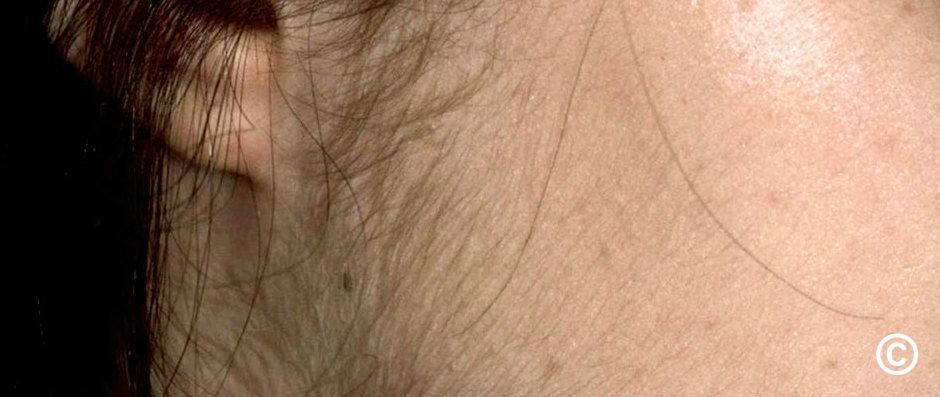
A 19-year old lady presents with excess facial hair. 


Examination

On examination the presence of excess coarse dark facial hair was noted.


Investigations

What other information do you need to know?

What investigations are required?

What is the most likely diagnosis?

Images

Diagnosis

RevealHide the answer

What other information do you need to know?

  • Has this come on gradually or suddenly?
  • Is there excess hair elsewhere?
  • Are there any anomalies of the menstrual cycle such as amenorrhoea or oligomenorrhoea (menstrual cycles longer than 35 days or fewer than 10 periods a year) 
  • Are there any other features of hyperandrogenism?
    • Dermatological manifestations of hyperandrogenism in women include hirsutism, recalcitrant acne, male pattern alopecia and sometimes acanthosis nigricans
    • Non-dermatological manifestations include obesity, irregular menses, a deepening voice, clitoromegaly, increased muscle mass and a decreased breast size
  • What medications does the patient take?
    • Drug-related causes include use of androgens, valproic acid, and ciclosporin
  • Is there a family history of hirsutism?
     

What investigations are required?

  • Measure early morning serum testosterone and SHBG levels in order to calculate the free androgen index (FAI). Measurement of total testosterone even using modern immunoassays has a low sensitivity for diagnosing some conditions such as the PCOS. This is because high concentrations of sex hormone binding globulin (SHBG) eg with the use of oral contraceptive pills, or low concentrations of SHBG eg in insulin resistance or obesity, can affect total testosterone values
    • The FAI can be calculated by the total testosterone concentration divided by the SHBG concentration and this figure multiplied by 100
    • A normal testosterone level is < 3
    • A normal FAI is < 7 if 20-50 years of age, and < 5 if over 50 years of age 
  • In patients who also have oligomenorrhoea, amenorrhoea or fertility problems also measure TFT, prolactin levels (hyperprolactinaemia), and FSH (to exclude primary ovarian failure)

What is the most likely diagnosis?

  • The most likely diagnosis is the Polycystic ovarian syndrome
  • PCOS is a diagnosis of exclusion. It typically presents in late teenage years in overweight individuals. Two of the following three criteria must be fulfilled for a diagnosis:
    • A clinical diagnosis of amenorrhoea or oligomenorrhoea (menstrual cycles longer than 35 days or fewer than 10 periods a year)
    • Clinical or biochemical (raised FAI, serum testosterone < 4) evidence of hyperandrogenism
    • Polycystic ovaries on ultrasound examination


For further reading on these subjects please refer to the following chapters, which have just been updated:

Latest Cases of the Month

September 2021 - Case of the Month

A 24-year-old woman presented with a several year&nbsp;history of evolving 'lumps' especially on the central chest. The lady had mild facial acne and was otherwise well.&nbsp;

August 2021 - Case of the Month

A 52 year old man presented with a one year history of skin lesions predominantly on his hands, ears and scalp. He was also complaining of painful swollen fingers associated with morning stiffness. There was no family history of skin or joint problem...

July 2021 - Case of the Month

A 72 year old man was referred with a rash, predominantly on the legs. The patient was systemically well and the&nbsp;lesions were only mildly symptomatic. The lesions presented as one to several at a time lasting several weeks. They&nbsp;had not res...

June 2021 - Case of the Month

Welcome back to the new look PCDS website, and our first case. This lady was referred as a 2-week wait with a changing lesion on the right temple.

September 2020 - Case of the Month

A 15 year old lady was referred for a diagnostic opinion for skin changes presenting in birth, affecting the right upper back, shoulder, antecubital fossa and dorsal wrist. The patient was asymptomatic and otherwise well.

The following pharmaceutical companies have had no involvement in the content of this website or in our conference programmes

Almirall
Galderma
Glenmark
Johnson & Johnson
La Roche-Posay
LEO Pharma
Pierre Fabre
Schuco