September 2021 - Case of the Month
A 24-year-old woman presented with a several year history of evolving 'lumps' especially on the central chest. The lady had mild facial acne and was otherwise well.

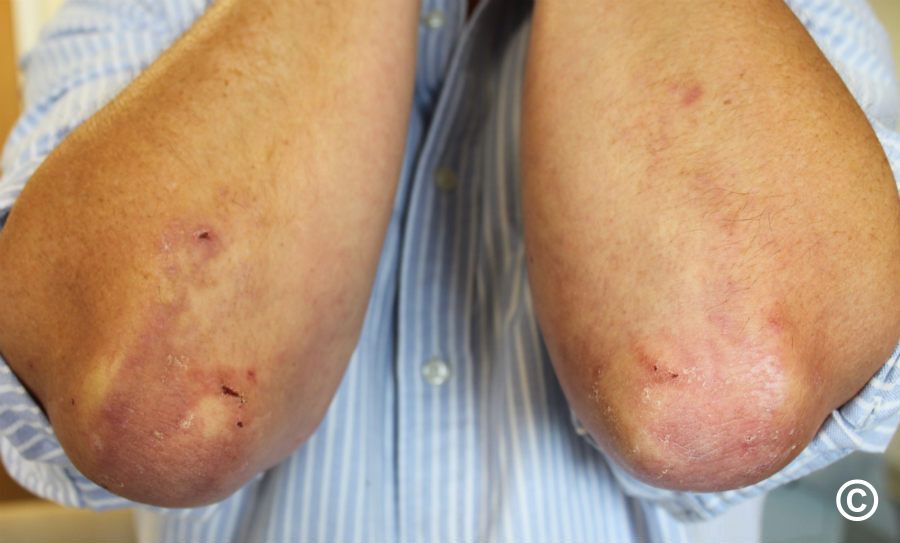
A 55 year old man presented with a six month history of an intensely itchy rash affecting his arms, knees and scalp. There were no clear exacerbating factors. Potent topical steroids had only given partial benefit.
There was no significant personal or family history of eczema, atopy or any other skin conditions.
The gentleman was otherwise well, and was on no medications.
There were numerous excoriated lesions on the aforementioned areas. The rest of the skin was normal. There were no changes of the nails or mucosal surfaces.
1. What investigations are needed?
2. What is the diagnosis?
3. What management is required?
The diagnosis was confirmed by the results of the two skin biopsies (one biopsy was taken for histology, the other for direct immunofluorescence), and a positive serum tissue transglutaminase level
The diagnosis is dermatitis herpetiformis (DH), which DH is an uncommon, and intensely itchy, chronic skin condition associated with gluten enteropathy, although few patients have significant gastrointestinal symptoms.
It is an immunobullous condition ie a blistering eruption caused by an abnormal immunological reaction. Up to 10% of patients have a positive family history of DH or coeliac disease (syn. gluten enteropathy), and there is an association with thyroid and other autoimmune conditions.
DH affects men more then women, and most commonly presents between the ages of 20-55, but may arise at any age.
Lesions of DH are intensely itchy. Some patients notice a fluctuation of symptoms related to the amount of gluten (found in grains such as wheat, barley and rye) in their diet. Although 90% of patients will have associated coeliac disease only a few are symptomatic, conversely 15-25% of patients with coeliac disease develop DH.
The rash is symmetrical, affecting the extensor surfaces of limbs (classically the knees and just below the elbows), the scalp, the scapula and the natal cleft. Other sites can also be affected. Lesions consist of small papules or vesicles, which are often grouped together on erythematous patches of skin. The intense itch of DH normally provokes vigorous scratching, which frequently destroys areas of vesicles / blisters and leaves behind erosions.
Management generally includes:
To read more about DH please refer to the Dermatitis Herpetiformis chapter
To learn more about the differential diagnoses of itchy rashes follow this link
A 24-year-old woman presented with a several year history of evolving 'lumps' especially on the central chest. The lady had mild facial acne and was otherwise well.
A 52 year old man presented with a one year history of skin lesions predominantly on his hands, ears and scalp. He was also complaining of painful swollen fingers associated with morning stiffness. There was no family history of skin or joint problem...
A 72 year old man was referred with a rash, predominantly on the legs. The patient was systemically well and the lesions were only mildly symptomatic. The lesions presented as one to several at a time lasting several weeks. They had not res...
Welcome back to the new look PCDS website, and our first case. This lady was referred as a 2-week wait with a changing lesion on the right temple.
A 15 year old lady was referred for a diagnostic opinion for skin changes presenting in birth, affecting the right upper back, shoulder, antecubital fossa and dorsal wrist. The patient was asymptomatic and otherwise well.
The following pharmaceutical companies have had no involvement in the content of this website or in our conference programmes