September 2021 - Case of the Month
A 24-year-old woman presented with a several year history of evolving 'lumps' especially on the central chest. The lady had mild facial acne and was otherwise well.

A 73 year old lady presented with a six month history of very itchy red spots that come and go with no obvious triggers, affecting any part of her body. Individual lesions last for several weeks. There was no other personal or family history of skin disease. The patient took thyroxine and amlodipine for hypertension, both of which she had been on for years. The patient was otherwise well.
There were several widely distributed smooth red papules, lesions did not urticate when rubbed.
What tests are needed and what is the likely diagnosis?
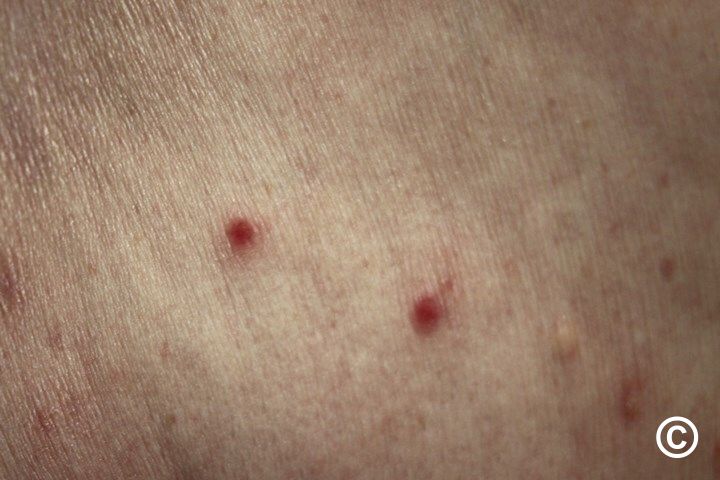
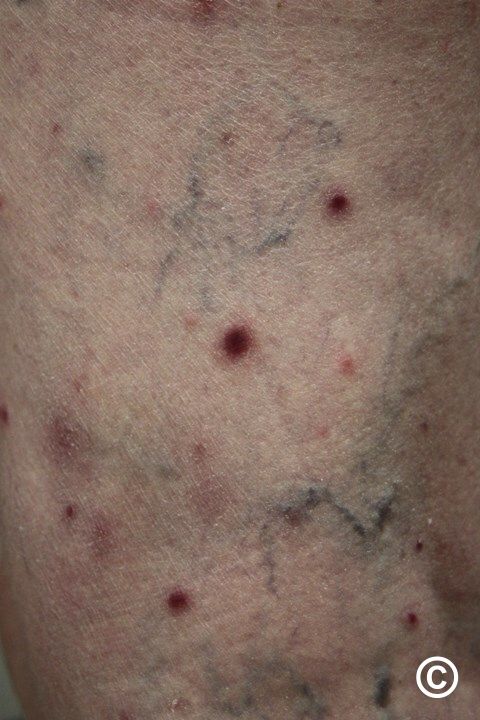
The eventual diagnosis (after investigations) was a dermal hypersensitivity reaction, which is a recognised histopathological finding that clinically is usually associated with very itchy scattered red papules. The condition is poorly understood and when no underlying cause is identified (as in this case) it is sometimes referred to as the red itchy bump disease.
Many aetiological factors have been proposed including insect bites, drugs, and vaccines. There have been occasional reports related to internal malignancies including lymphoma. In cases secondary to insect bites the diagnosis is referred to as papular urticaria, in such cases lesions tend to be grouped on exposed areas and can blister, non-exposed sites can be affected.
Except in papular urticaria other cases of red itchy papules require a thorough history (including systematic enquiry), examination and routine blood screen (haematology and biochemistry), and a biopsy of one of the lesions to look for an alternative diagnosis as dermal hypersensitivity is a diagnosis of exclusion. Histology usually shows a mild superficial perivascular lymphocytic infiltrate with no or minimal deep dermal extension, associated with some perivascular and interstitial eosinophils and mild dermal oedema. Usually the epidermis is normal or only mildly spongiotic. Sometimes, lymphocytic vasculitis is associated.
Where a cause cannot be identified the condition can be difficult to treat. Response to super-potent topical steroids, topical preparations containing menthol, and the periodic use of sedating antihistamines can be tried but response is often poor. Patients with persistent symptoms not responding to treatment should be referred for further evaluation and treatment, which in the first instance is likely to be a trial of phototherapy. For more information refer to the relevant chapter.
A 24-year-old woman presented with a several year history of evolving 'lumps' especially on the central chest. The lady had mild facial acne and was otherwise well.
A 52 year old man presented with a one year history of skin lesions predominantly on his hands, ears and scalp. He was also complaining of painful swollen fingers associated with morning stiffness. There was no family history of skin or joint problem...
A 72 year old man was referred with a rash, predominantly on the legs. The patient was systemically well and the lesions were only mildly symptomatic. The lesions presented as one to several at a time lasting several weeks. They had not res...
Welcome back to the new look PCDS website, and our first case. This lady was referred as a 2-week wait with a changing lesion on the right temple.
A 15 year old lady was referred for a diagnostic opinion for skin changes presenting in birth, affecting the right upper back, shoulder, antecubital fossa and dorsal wrist. The patient was asymptomatic and otherwise well.
The following pharmaceutical companies have had no involvement in the content of this website or in our conference programmes