September 2019 | Case of the month

History

Two patients present with gradual hair loss, one male and one female. They have no scalp symptoms, and both have at least one parent who started to loose hair at a relatively young age. Both patients were well, took no medications. The female patient had no hirsutism or signs of virilisation. 


Examination

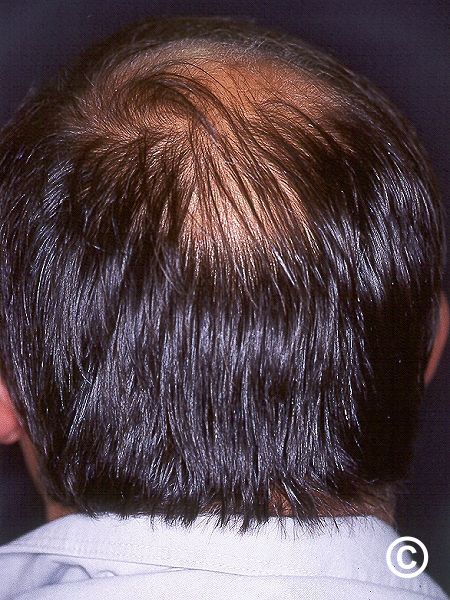
Male patient (figure 1)

  • Non-scarring alopecia
  • Recession of the frontal hair line, mainly in a triangular pattern is the characteristic finding, later followed by thinning of the vertex
     

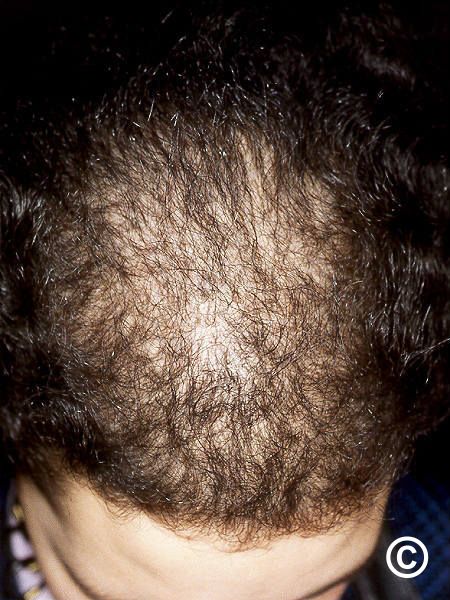
Female patient (figure 2)

  • Non-scarring alopecia
  • Diffuse thinning of the centroparietal region with maintaining of the frontal hair line (Ludwig pattern)

Investigations

What are the diagnoses and what are the management options?


Images

Diagnosis

RevealHide the answer

The diagnoses are male pattern and female pattern alopecia.

For thorough notes on management refer to the relevant chapter, some of the key points are as follows:

  • If uncertain as to whether it is female pattern or generalised alopecia check FBC, ferritin and TFT
  • Refer to the condition as alopecia rather than baldness
  • Provide patients information leaflets and give details for Alopecia UK (on the chapter linked above)
  • Hair products containing nanofibres can help stick hair together to give an appearance of thicker hair
  • Assess levels of psychological distress - always important when considering treatment, including the potential costs to the patient when not all patients will benefit
  • Minoxidil 
    • Is a topical treatment that can be used for mild-moderate alopecia
    • Upto 40% of patients may benefit 
    • Minoxidil does not alter the natural history of hair loss, but rather it can thicken / increase the density of remaining hair
    • The 5% formula is recommended BD for men and OD for women
    • Minoxidil comes as a solution or foam - the easiest way to measure the correct amount is to use a large tangerine-sized blob of the foam
    • The response to treatment should be assessed at six months - if beneficial treatment needs to be continued to maintain efficacy
    • Patients should not be referred for this treatment
  • Other medical treatments:
    • Men: Finesteride is used by some men (refer to the linked chapter)
    • Women: if there is associated hyperandrogenism patients can be considered for treatment with anti-androgens, although evidence for a satisfactory response is lacking - refer to the related chapter on Hyperandrogenism
  • ​Wigs
    • Can be considered for patients with moderate to severe alopecia
    • Patients can be referred (normally to local dermatology departments) for the provision of wigs, which are of sufficient quality to normally make for a good cosmetic appearance
  • Surgery
    • Can be performed in both male and female patients, although the outcomes appear better for men
    • Patients need to have sufficient donor hair - the best site is from the neck region of the scalp
    • Outcomes are variable, and depend to a large extent on the skill / experience of the surgeon
    • Treatments are very expensive and patients need to give considerable thought before having such a procedure performed

Latest Cases of the Month

September 2021 - Case of the Month

A 24-year-old woman presented with a several year history of evolving 'lumps' especially on the central chest. The lady had mild facial acne and was otherwise well. 

August 2021 - Case of the Month

A 52 year old man presented with a one year history of skin lesions predominantly on his hands, ears and scalp. He was also complaining of painful swollen fingers associated with morning stiffness. There was no family history of skin or joint problem...

July 2021 - Case of the Month

A 72 year old man was referred with a rash, predominantly on the legs. The patient was systemically well and the lesions were only mildly symptomatic. The lesions presented as one to several at a time lasting several weeks. They had not res...

June 2021 - Case of the Month

Welcome back to the new look PCDS website, and our first case. This lady was referred as a 2-week wait with a changing lesion on the right temple.

September 2020 - Case of the Month

A 15 year old lady was referred for a diagnostic opinion for skin changes presenting in birth, affecting the right upper back, shoulder, antecubital fossa and dorsal wrist. The patient was asymptomatic and otherwise well.

The following pharmaceutical companies have had no involvement in the content of this website or in our conference programmes


Almirall
Galderma
Glenmark
Johnson & Johnson
La Roche-Posay
LEO Pharma
Pierre Fabre
Schuco