
Erysipeloid

LAST UPDATED: Nov 22, 2021
Introduction

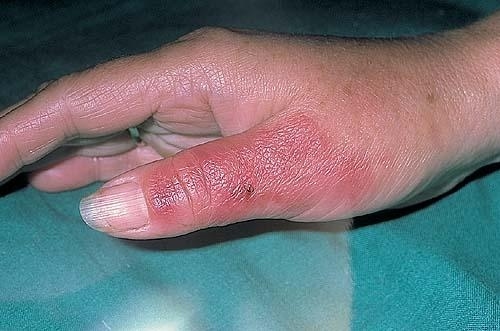
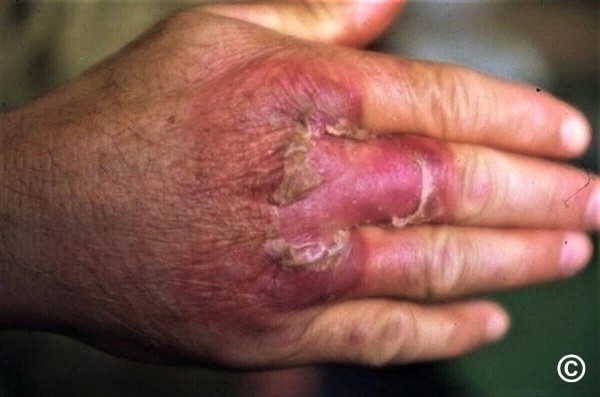
Erysipeloid is an uncommon cutaneous infection with a Gram-positive corynebacteria, Erysipelothrix rusiopathiae. The characteristic clinical features are a slowly evolving red-purple eruption, predominantly on the fingers and hands, in a patient who is constitutionally well.

This chapter is set out as follows:


Aetiology

  • Human infection is acquired through direct contact with contaminated raw fish or meat, the infection entering the skin through an abrasion. Infection from a living animal is uncommon

History

  • Incubation period - three days

Clinical findings

Distribution

  • Predominantly the fingers and hands, occasionally other exposed sites

Morphology

  • A hot and tender, purple-red, slightly oedematous eruption
  • The leading edge is raised, well-defined, irregular, and sometimes vesicular
  • The rash slowly evolves over 3-4 days, generally to a size of no more than 10 cm in diameter
  • The rash has a tendency to heal at its original site
  • Unlike in cellulitis/erysipelas, systemic upset is very uncommon
  • The eruption usually resolves within 2-4 weeks  

Other presentations (rare)

  • A diffuse cutaneous form with violaceous lesions, which have an advancing pink edge and central resolution. There can be associated systemic upset. The eruption may run a longer course than localised erysipeloid, and there can be recurrences
  • A severe, potentially life-threatening, systemic form with endocarditis and other organ involvement. Patients have marked systemic upset, and blood cultures are normally positive. Skin lesions may or may not be apparent

Clinical Images

Please refer to notes on image rights at bottom of the page with regards to individual image ownership.

Management

  • The lesions of cutaneous erysipeloid (local and diffuse) are usually self-limiting, however, treatment with antibiotics speed up the healing process and lessen the chance of the infection becoming systemic
  • The first-line treatment is penicillin, or, clarithromycin/erythromycin for those allergic to penicillin
  • The organism can survive outside of the body, so decontamination of suspect environments is important

Disclaimer - the author PCDS cannot accept responsibility for any misleading or incorrect statements, and the management of individual patients remains the direct responsibility of the individual doctor. We do however hope that visitors to this site can contact us regarding comments that are considered misleading or incorrect so that we can continue to improve the site.

Image Rights - The PCDS would like to thank Dermatoweb, DermQuest (Galderma), and others who have contributed images. All named individuals and organisations maintain copyright for the relevant images.

Quick Links

The following pharmaceutical companies have had no involvement in the content of this website or in our conference programmes


Almirall
Galderma
Glenmark
Johnson & Johnson
La Roche-Posay
LEO Pharma
Pierre Fabre
Schuco