LAST UPDATED: Jan 31, 2025

Atopic eczema (atopic dermatitis) is the most common form of eczema, a condition that causes the skin to become itchy, dry, and inflamed. Although it is more common in children, often developing before their first birthday, it can develop for the first time at any age.
Atopic eczema is usually a long-term (chronic) condition, although it can improve for a period, or even clear completely in some children, as they get older.
The term atopic is used to describe a group of related conditions, which include asthma, eczema, and hay-fever.
Atopic eczema is itchy, which can be severe enough to interfere with sleep, causing tiredness and irritability. Typically, atopic eczema goes through phases of being worse (a flare-up), more settled, and then worse again. Sometimes the triggers for a flare-up can be identified, but often no cause is found.
Atopic eczema can affect the face, joint creases and other body folds (collectively known as the flexures) or can be generalised.
The skin is often dry with fine scale with poorly-defined (cannot draw a border around it) areas of redness (erythema). In skin of colour the redness can be more difficult to see, and sometimes the affected areas become darker in colour. Other common appearances of atopic eczema include coin-sized areas of inflammation on the limbs (a discoid pattern), and numerous small bumps around the hair follicles, mainly in skin of colour.
In atopic eczema the skin may also weep, blister, crust, crack (fissure) or thicken (lichenification).


Atopic eczema is a complex condition; several factors appear important for its development including:
The barrier function refers to the outer skin layer (the Stratum Corneum), which is analogous to a brick wall. In the skin the bricks are dried out, non-living cells called corneocytes. The bricks are held together by mortar/cement, referred to as the intercellular matrix; composed of lipids.
In healthy skin this brick wall is highly impermeable, keeping water loss to a minimum and preventing small particles such as irritants, allergens, and infection from getting into the skin.
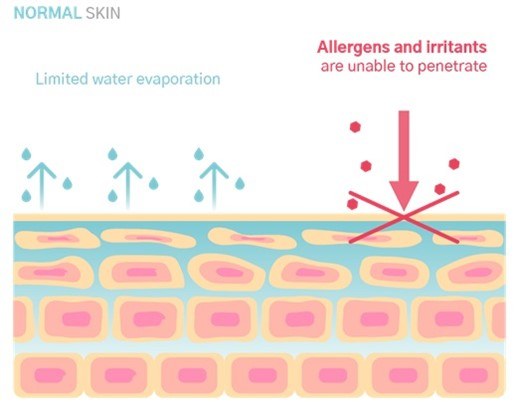
In eczema, the skin barrier becomes less effective; this can happen naturally as we get older, or in atopic eczema because of a faulty gene, which explains why atopic eczema runs in families. Essentially, the bricks are crumblier and the mortar/cement is less effective at holding everything together, resulting in too much water escaping from the skin (the skin dries out), and allowing more irritants and allergens to penetrate the skin, causing itching and inflammation. Accordingly, managing the skin barrier effectively is one of the most important aspect of treating eczema.

If your eczema is not responding to the measures described above, then make an appointment to see a health professional. This link provides detailed advice on specific treatments.
General notes on treatment:
One of the most important aspects of treatment is a management plan informing you which treatments to use where and when. The PCDS website has a management plan that your health professional can easily complete and print off for you should they choose.
This is caused by an infection with the cold sore virus (herpes simplex), usually arising in people with a history of atopic eczema. It causes a sudden painful widespread eruption of weeping small sores, looking different to your eczema. If left, the person will feel hot and shivery and generally unwell. It can occasionally get into the blood stream or eyes, which can be profoundly serious - if you suspect eczema herpeticum you must seek urgent medical attention. For more information follow this link.
Eczema can have a significant psychological impact and may affect many areas of daily life including school, work, and personal relationships. If the atopic eczema is affecting your mental health the National Eczema Society offers helpful advice in this link. If your mental health continues to be affected, then you should discuss this with a health professional.
The following groups of people may need to be referred to a specialist, who would usually be a dermatologist or a GPwER/GPwSI (a GP who has been trained in relevant areas of dermatology):
Food allergy - if a young child has been found to have a milk allergy, then a dietician will need to be involved. If the child has more severe reactions to food and/or several possible food allergies, then they will need to be referred to an immunologist or a paediatrician with a special interest in food allergy.
People suspected of having a contact allergic dermatitis may require patch testing - substances are applied to the back in special, small circular containers and left on for a few days to identify any chemicals that you may be allergic to.
For those not suspected of having contact allergic dermatitis (most people) then the appointment may be face-to-face (the person attends the clinic), or a video call (teledermatology).
Treatment options can include alternative topical treatments (creams, ointments, gels), a course of light treatment (phototherapy), oral medications (tablets) to lessen the immune reaction in your skin (immunosuppressive drugs), or injections.
Please take to your appointment a list of the treatments that you are currently using (and have used) for your eczema, as the specialist may not otherwise know.
Itchy skin conditions can understandably lead to behaviours such as scratching, rubbing, and/or picking as ways to try and cope. Eventually the behaviours can become habits. Habit reversal therapy is a treatment programme that offers a solution to the behaviour that has developed. Unfortunately therapy is not widely available, however, if you have developed such a habit then ask a health professional to see if there are any local services providing habit reversal therapy; alternatively you can do a Google search. The following link provides a patient information leaflet on habit reversal therapy in children, and this link for adults.
Unfortunately not, but there are many ways of improving eczema. Most children affected by atopic eczema will improve as they get older, with 60% being clear of it by their teens. However, many of these people continue to have dry skin and will therefore benefit from lifelong avoidance of irritants such as soaps and detergents.
In later life, atopic eczema can recur or present as hand eczema (hand dermatitis), which may be troublesome for people in certain jobs that involve contact with irritant materials, such as catering, hairdressing, cleaning, or healthcare work.
This leaflet mentions ‘emollients’ (moisturisers). Pure petroleum emollients are flammable and should never be used near a naked flame. Non-paraffin-based emollients may also act as accelerants if they have a high oil content, so caution is advised with all topical treatments.
Your hands may be slippery after applying a greasy moisturiser, so allow time for them to soak in before driving or operating machinery.
If you, a family member, or friend have an undiagnosed skin condition; or you want to learn more about how to treat skin conditions, please view our short video on how to get the best from this website.
Disclaimer - the author PCDS cannot accept responsibility for any misleading or incorrect statements, and the management of individual patients remains the direct responsibility of the individual doctor. We do however hope that visitors to this site can contact us regarding comments that are considered misleading or incorrect so that we can continue to improve the site.
Image Rights - The PCDS would like to thank Dermatoweb, DermQuest (Galderma), and others who have contributed images. All named individuals and organisations maintain copyright for the relevant images.
The following pharmaceutical companies have had no involvement in the content of this website or in our conference programmes