
5-fluorouracil cream (5-FU) cream

LAST UPDATED: Dec 05, 2025

Patient Information Leaflet
Link: 5-fluorouracil cream (5-FU) cream

https://www.pcds.org.uk/patient-info-leaflets/efudix-5-fu-cream-for-actinic-keratoses

What is 5-fluorouracil cream (5-FU) cream and how does it work?

5-fluorouracil cream (5-FU) cream is a treatment that targets sun-damaged skin cells known as actinic keratoses, whilst leaving healthy skin cells alone. Actinic keratoses can be recognised as small flat lesions on sun-damaged skin that have a rough scaly surface. 5-FU cream comes in two strengths, 5% 5-FU and the slighter weaker 4% 5-FU.  5-FU cream is often highly effective but may not be suitable for everyone.

The 5% 5-FU cream can also be used to treat Bowen’s disease and superficial basal cell skin cancer. 
How do I use 5-FU cream?

  • The cream is applied thinly using a fingertip. Do not cover the treated areas with a plaster unless your health professional says otherwise. Wash your hands thoroughly after applying the cream
     
  • You may be advised to use the 5-FU cream once or twice a day for up to 4 weeks (actinic keratoses) or up to 6 weeks (basal cell carcinomas) - follow the advice given by your healthcare professional
     
  • If you apply 5-FU cream in a morning, wait 20 minutes before applying any moisturisers and/or cosmetics. Wash off after approximately 8 hours. If 5-FU cream is applied at night, wash off the following morning
     
  • Warning - do not apply to your eyelids or lips and avoid contact with your eyes and mouth. Extra care also needs to be taken on the lower legs where there is a risk of developing a leg ulcer. Do not use if you are pregnant or breastfeeding, or if you are allergic to any of the ingredients. Keep the medication away from children and pets. Harm or death to pets may occur from licking treated areas on patients. If the medication is swallowed by an adult or child, please contact the Accident and Emergency (A&E) department at your local hospital

What to expect during the course of treatment

  • Timing - if you have something important coming up, such as a holiday or a special social occasion, it is sensible to start treatment on your return/afterwards
     
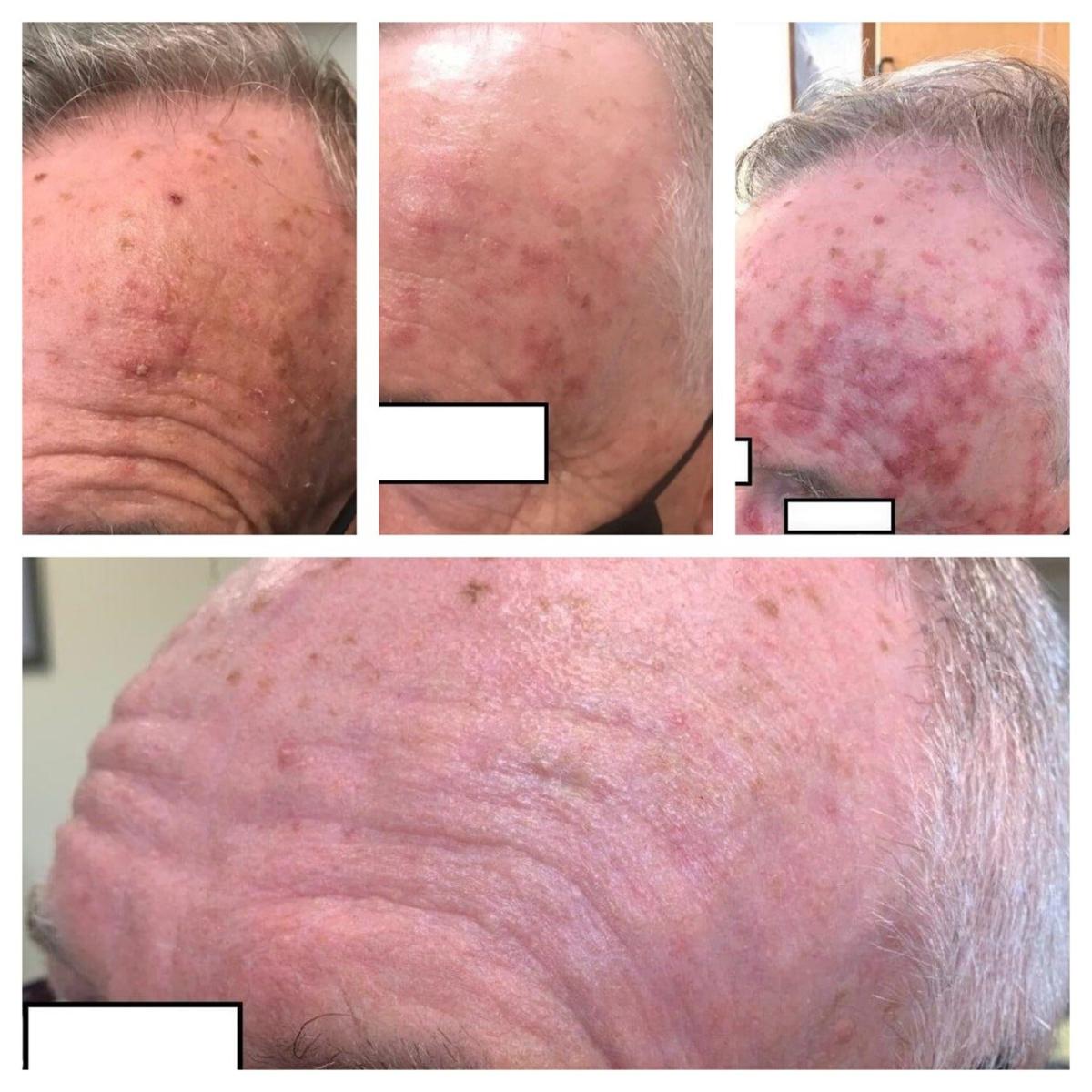
  • Expect inflammation in the skin leading to redness, soreness, oozing and scabs, sometimes areas of untreated skin close by may also be affected - please continue to apply the creams if this occurs, the more sun-damaged the skin, the stronger the reaction will be. The images below show how the skin may look before, during, and several weeks after the treatment has finished 
     
  • Sun protection is very important during treatment as the 5% 5-FU cream makes your skin more sensitive to sunlight which can make the reaction to the treatment more severe. Limit sun exposure during and after treatment, until the skin has healed. Use a broad-spectrum sunscreen (SPF 30 or above) and protect the treatment area with a hat or clothing
     
  • It may take the skin 6-8 weeks to fully settle once treatment is complete. The regular use of an emollient cream will help
     
  • If the reaction is very severe, painful or more than you can tolerate, or you feel unwell, please stop the creams and contact a relevant healthcare professional who may recommend applying a steroid cream to settle the reaction. There is a small risk of developing permanent scarring or changes in skin colour following a severe reaction to treatment.

Upper images show the expected reaction to 5% 5-FU cream over a 4 week treatment period. The lower image shows the skin 3 months after the treatment had finished (click on the images to enlarge).

Will the treatment cure my skin condition?

Actinic keratoses are a marker of the amount of sun that your skin has been exposed to, and to its susceptibility to sun-related change.

The cream will reduce the number of actinic keratoses, which in turn will reduce your risk of skin cancer.

Over time more actinic keratoses will develop, meaning that the treatment needs to be repeated. Rather than treating each actinic keratosis as it arises, it may be preferable to wait until you get a crop of new lesions (e.g. 5-10) before repeating the treatment.

Disclaimer - the author PCDS cannot accept responsibility for any misleading or incorrect statements, and the management of individual patients remains the direct responsibility of the individual doctor. We do however hope that visitors to this site can contact us regarding comments that are considered misleading or incorrect so that we can continue to improve the site.

Image Rights - The PCDS would like to thank Dermatoweb, DermQuest (Galderma), and others who have contributed images. All named individuals and organisations maintain copyright for the relevant images.

Download the Patient Information Leaflet PDF

Download

The following pharmaceutical companies have had no involvement in the content of this website or in our conference programmes


Almirall
Galderma
Glenmark
Johnson & Johnson
La Roche-Posay
LEO Pharma
Pierre Fabre
Schuco