LAST UPDATED: Jan 31, 2025

https://www.pcds.org.uk/patient-info-leaflets/keratosis-pilaris
Keratosis pilaris (KP) is a very common skin condition often seen in children and young adults. “Keratosis” means a build-up of keratin or scale in the skin and “pilaris” comes from the word for hair. In KP there is a build-up of scale which blocks or plugs the hair follicles. KP may become more obvious in teenage years, but often clears in adults.
Tiny scaly bumps (1-2mm) are seen on the outer part of the upper arms and fronts of the thighs. The outer part of the cheeks are commonly affected and sometimes the rash is also found on the buttocks, chest, and back. In pale skin the bumps may appear red. They may look brown or black in more deeply pigmented skin types. Some people can be bothered by the appearance of their skin which can look like permanent “goosebumps''. The skin can feel rough and dry and may sometimes feel itchy.
Occasionally KP can cause scarring of hair follicles. This is more common in rare forms of KP, namely atrophoderma vermiculatum and keratosis rubra pilaris facei atrophicans, the latter can cause loss of eyebrow hair.
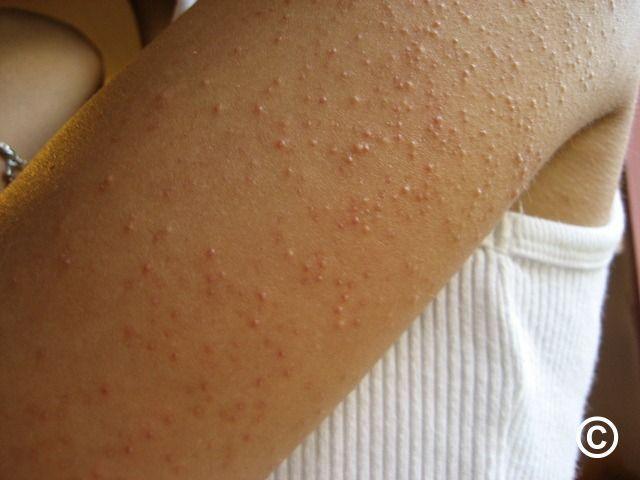
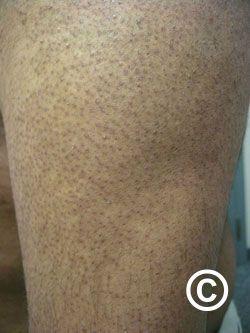

The exact cause of KP is not fully understood. Mild forms are best seen as a variation of normal skin. It is commonly found in more than one member of a family but the exact way that it is inherited can vary from family to family.
It is not infectious meaning that it cannot be passed on from one person to another.
KP may be easier to see in the winter months when the skin is more likely to be dry and when more clothes are worn, which may rub on the skin. It is more common in people with atopic eczema, ichthyosis vulgaris, diabetes, and in people with Down’s Syndrome.
There is no cure for KP. Most people do not need treatment. Some people find that using moisturising creams (also called emollients) can help soften the skin if used frequently, these can also be used instead of soap. Moisturisers can be bought without a prescription either from your pharmacist or online. Emollients containing urea or salicylic acid sometimes help to smooth the skin surface. These can also be bought, or prescribed by your GP. The use of gentle exfoliation with a scrub or sponge may help.
Most patient do not need to see a healthcare professional. If KP is really troubling you, various treatments can be prescribed but none of these are reliably effective.
Treatment options provided by a healthcare professional include topical steroid creams (anti-inflammatory creams). A moderately potent (middle strength) topical steroid cream may help some patients when the skin is very red but should only be used for a few days at a time and not for long-term regular use as they may cause skin thinning.
Topical retinoid creams are related to vitamin A. These may help reduce the roughness of the skin in some patients; they can irritate the skin if used too often.
If the appearance of your skin is affecting your mental health you should discuss this with a healthcare professional.
Referral is not normally needed; KP usually improves over time and there are no other treatments available on the NHS. Occasionally, a referral may be needed if the diagnosis is not clear, which can be the case in some of the rarer forms of KP. Referral can be to either a dermatologist or a GPwER/GPwSI in Dermatology (a GP who has been trained in relevant areas of dermatology).
The appointment may be face-to-face (the person attends the clinics), or a video call (teledermatology). If the diagnosis is not clear a small sample of skin (a biopsy) may be taken under local anaesthetic to be examined under a microscope. Other treatments sometimes considered include laser therapy, but these are not available on the NHS.
Further information can be found on the clinical chapter Keratosis pilaris.
If you, a family member, or friend have an undiagnosed skin condition; or you want to learn more about how to treat skin conditions, please view our short video on how to get the best from this website.
Disclaimer - the author PCDS cannot accept responsibility for any misleading or incorrect statements, and the management of individual patients remains the direct responsibility of the individual doctor. We do however hope that visitors to this site can contact us regarding comments that are considered misleading or incorrect so that we can continue to improve the site.
Image Rights - The PCDS would like to thank Dermatoweb, DermQuest (Galderma), and others who have contributed images. All named individuals and organisations maintain copyright for the relevant images.
The following pharmaceutical companies have had no involvement in the content of this website or in our conference programmes