
LAST UPDATED: Jan 31, 2025

Lichen Planus is a disorder that can affect any part of the skin and/or mucosal surfaces of the body. It is not infectious nor contagious. It usually persists over time (it is a chronic disorder) before usually stabilising and resolving. It is a condition in which the immune system is set off inappropriately and causes damage and inflammation. It is not a harmful or dangerous condition in that it does not lead to serious harm to the body. Your General Practitioner (GP) can diagnose, start treatments, and support you, or refer you for diagnosis and treatment where needed.
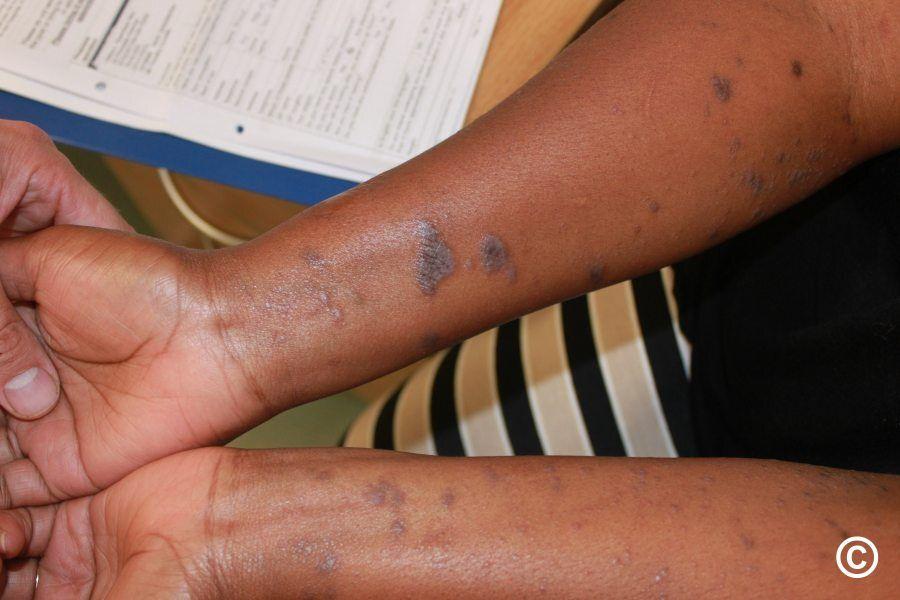
Since lichen planus can affect any part of the skin or mucosal surface, its appearance depends on the area involved. Classically, lichen planus is an itchy eruption, consisting of slightly raised, purplish/mauve flat-topped spots on areas such as the wrists, legs, and tops of the feet. In skin of colour the spots may be dark brown or black. The spots may have lacy white streaks over them, when fresh. The spots may join to form larger patches. The rash may spread over the body.
In other forms, lichen planus can affect the scalp, causing either patchy hair loss (lichen planopilaris) or affecting the front hairline, causing it to seemingly move backwards (frontal fibrosing alopecia). Hair destruction can be permanent. Lichen planus can involve the nails, causing altered appearances such as excess dryness and ridging of the nails, discolouration of the nails, lifting off of the nail edges, thickened skin under the nails, and finally, permanent nail destruction and nail loss. Lichen planus can affect the penis, sometimes leading to foreskin damage that may lead to permanent scarring and inability to retract the foreskin or causes erections to be painful, and can affect the vulva and vagina, again, causing itch or soreness, and scarring. Some people suffer with oral lichen planus, where the gums and inner surfaces of the mouth are affected, and rarely, can develop it in the oesophagus, causing swallowing difficulties. It is rare, but not impossible, to develop anal lichen planus.
Rare forms of lichen planus include lichen planus pigmentosa, which causes dark patches to develop on the face, neck, armpits, elbows, groins, and knees. Rarely, lichen planus can appear as blisters.
A person may have only the skin, or one site involved, or have many areas affected.


An exact cause for the development of lichen planus has not been found. Possible triggers may include the following:
It is important to keep your skin moisturised; moisturising helps restore the skin barrier, which may be damaged by the inflammation. Moisturising will also reduce itch. Cooling creams (moisturisers with menthol) may also reduce itch; these can be applied as often as are needed. Do remember that moisturisers are flammable; keep yourself, and anything they may come in to contact with, from naked flames.
Lichen planus is diagnosed, in most cases, by the characteristic symptoms and appearance. Make an appointment with your General Practitioner; if a diagnosis cannot be made, you may either be referred to a skin specialist, such as a GPwER/GPwSI (a GP who has also been trained in relevant areas of dermatology), or a Dermatologist. Treatments can be prescribed by your GP to start easing your symptoms.
Some of the treatments your GP may prescribe are:
The PCDS website has helpful guidance for your GP to help support decision-making.
Finally, lichen planus is rarely serious or life-threatening. In certain situations, such as hypertrophic lichen planus (very thickened areas of lichen planus, more common in patients with skin of colour), rapid change, growth, pain, or bleeding from an otherwise longstanding area of lichen planus could indicate the development of a squamous cell carcinoma (skin cancer) and patients must seek urgent advice from their GP or specialist. The same advice applies to penile or vulval lichen planus; in particular, any bloody vaginal discharge or pain and/or bleeding from the skin of the penis should prompt an urgent assessment with your GP or specialist.
Lichen planus has been associated with depression, anxiety, irritability, and stress. It is an itchy condition, mostly, and itch is a frustrating symptom. It is not a surprise that symptoms are worse when once is rundown, tired, stressed, and their mood affected, and vice versa. Seeking help via the General Practitioner and access to psychological therapies, to improve one’s mental health, may help one to cope and manage the lichen planus.
A specialist may be needed to diagnose lichen planus, especially the uncommon types, or lichen planus affecting the hair and nails. Some treatments, specialist treatments, are only available in hospital.
Most specialist Dermatology GPs (GPwER/GPwSI) and Dermatologists can diagnose lichen planus with assessment in the clinic; in some cases, where there is doubt, or where other diagnoses need to be ruled out, sometimes a biopsy needs to be taken. This is a short operation where a small piece of skin is removed, cut out of the skin or area, after being numbed with (local) anaesthetic. This is performed awake; you will leave the department and go home after this procedure. You may have sutures in the wound.
Once diagnosed; usually treatments will be discussed and started. Treatments depend on the extent and site of the lichen planus. These can include steroid tablets or injections, therapy with ultraviolet light (phototherapy), tablet medicines such as acitretin and hydroxychloroquine, and tablets that suppress your immune-system. It is important to remember that these treatments complement treatments already prescribed by your GP.
Lichen planus cannot be cured by treatments. In most cases, lichen planus resolves itself. Available treatments aim to improve symptoms, make the disease course milder, and aim to reduce risks such as permanent hair loss (in scalp lichen planus). Lichen planus can sometimes have a waxing and waning course before eventually resolving; here, there may be periods of active disease, marked by symptoms such as itch or soreness, interspersed with periods of inactivity, where there are no symptoms. Lichen planus on the skin may resolve with ‘staining’ where rashes may look dark. These patches may take years to resolve; sometimes, they are permanent.
Several support groups exist for lichen planus:
If you, a family member, or friend have an undiagnosed skin condition; or you want to learn more about how to treat skin conditions, please view our short video on how to get the best from this website.
Disclaimer - the author PCDS cannot accept responsibility for any misleading or incorrect statements, and the management of individual patients remains the direct responsibility of the individual doctor. We do however hope that visitors to this site can contact us regarding comments that are considered misleading or incorrect so that we can continue to improve the site.
Image Rights - The PCDS would like to thank Dermatoweb, DermQuest (Galderma), and others who have contributed images. All named individuals and organisations maintain copyright for the relevant images.
The following pharmaceutical companies have had no involvement in the content of this website or in our conference programmes