LAST UPDATED: Jan 31, 2025
Psoriasis is a common and usually long-term (chronic) condition that can appear at any age, although most commonly arises between the ages of 15–25 and 50–60 years old. There are several types of psoriasis that can affect your skin, scalp, and nails in different ways.
Psoriasis can also affect the joints (psoriatic arthritis), mental health, and in moderate to severe psoriasis, increases the risk of heart disease and stroke. Uncommonly, psoriasis can be associated with inflammatory bowel disease (Crohn’s disease and ulcerative colitis) and inflammation of the eye (uveitis).
In some people psoriasis can be itchy.
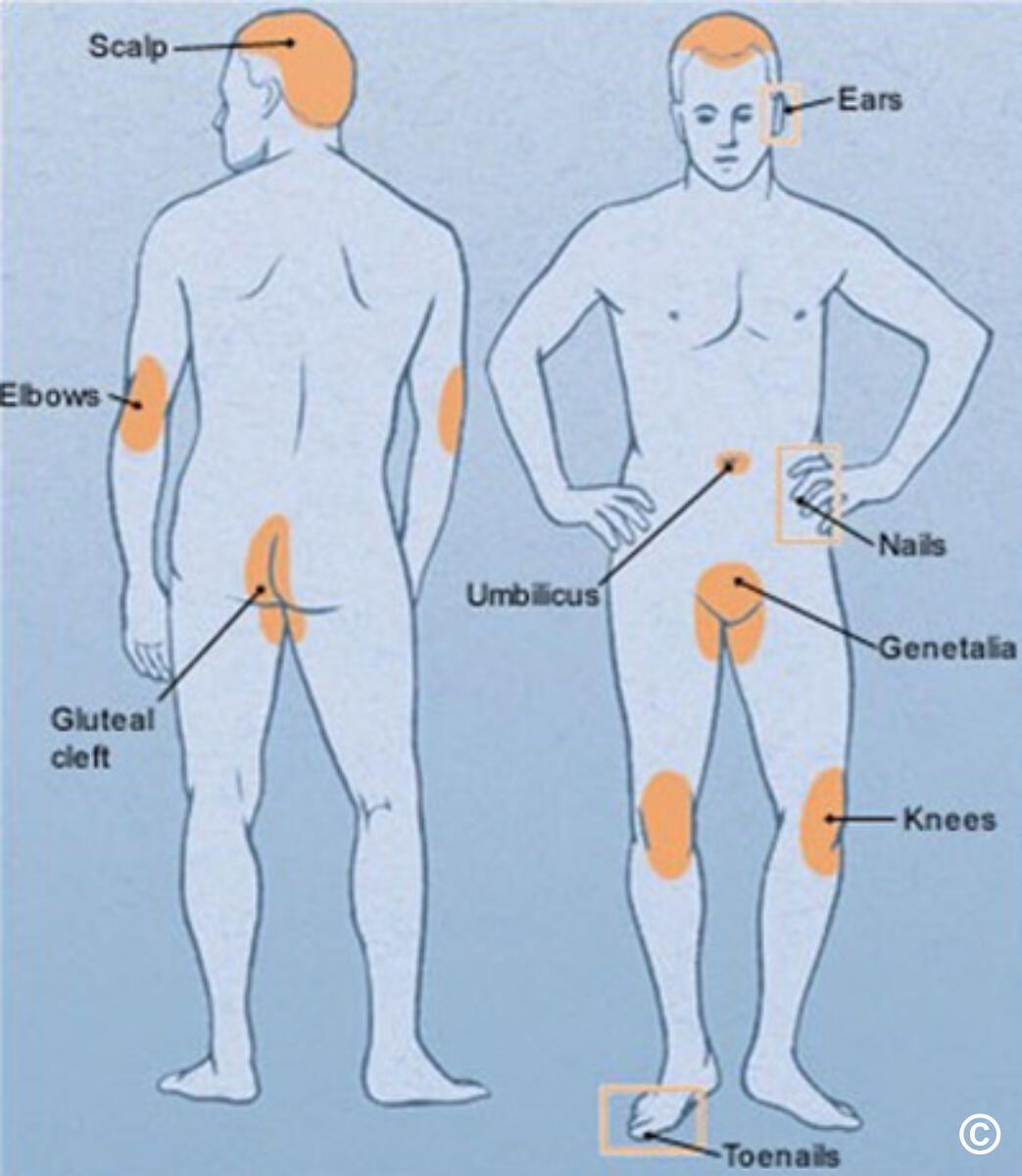
The most common type of psoriasis is chronic plaque psoriasis, with well-defined (i.e. easy to draw around) slightly raised pink-red plaques with silvery-white scales. In skin of colour the plaques can be darker than the surrounding skin, and the scales grey. Many people have just a few plaques that are several centimetres in diameter (large plaque psoriasis), usually present on the knees, elbows, trunk, scalp, ears and between the buttocks. Some people have many plaques covering large areas of their body. A variation is the presence of many smaller scaly plaques (small plaque psoriasis).
Genital involvement is not uncommon and must be brought to the attention of your health professional as treatment can help.
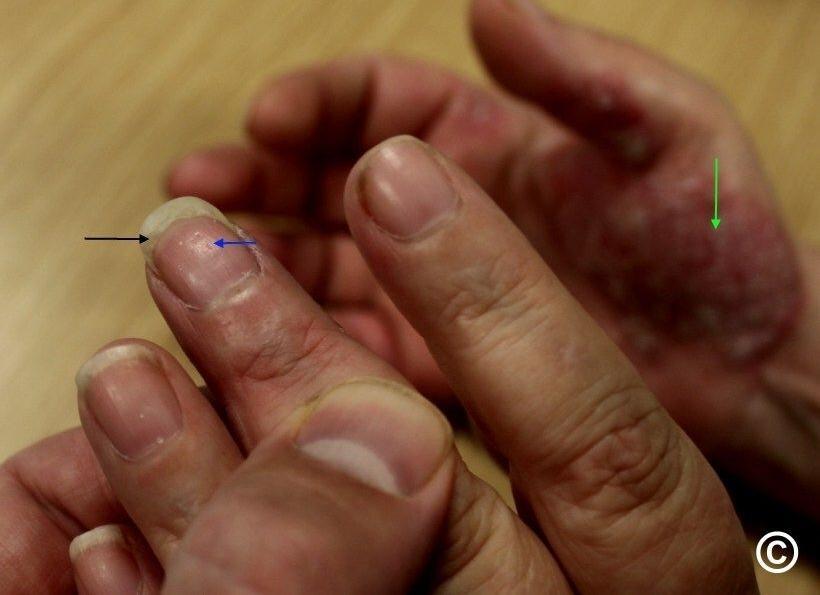
Nails can be involved, and sometimes this is the only sign of psoriasis. Nail changes include small indentations (pitting) of the surface, separation of the nail plate from the nail bed (onycholysis), pink areas of discolouration under the nail, thickening and yellowing of the nails, and complete nail destruction.



Other types of psoriasis include the following:

Guttate psoriasis - this is sometimes confused with small plaque psoriasis, although its’ appearance and behaviour differ. It is often caused by a bacterial throat infection (Streptococcus), presenting with very many small drop-like lesions over the trunk and limbs. The lesions are raised, and in the initial stages there may be little scale. The lesions usually fade over a few months but can recur. Some people with guttate psoriasis go on to develop other types of psoriasis.

Flexural psoriasis - sore, red, shiny patches of skin in the body folds (armpits, groin and under the breasts). This can be part of chronic plaque psoriasis, or the only feature.

Hyperkeratotic psoriasis - thickened scaly plaques on the palms and heels/soles.

Palmoplantar pustular psoriasis - many painful small brown and yellow spots on the soles and sometimes the palms; strongly associated with smoking.

Generalised pustular psoriasis - a rare type of psoriasis where the plaques on the trunk and limbs are studded with tiny yellow pus-filled spots. It can be localised (affecting a small area) or generalised (affecting most of the body) and can flare rapidly, requiring hospital admission. This condition is NOT associated with palmoplantar pustular psoriasis.
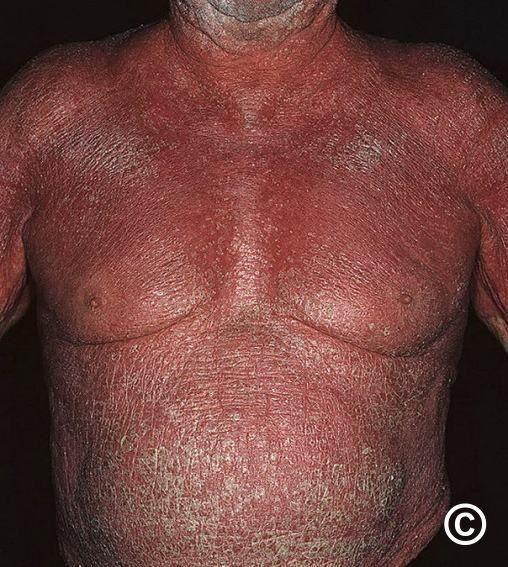
Erythrodermic psoriasis - a rare form of psoriasis that affects nearly all the skin and sometimes require hospital admission.
Psoriasis in children
Psoriasis can present less commonly in children; it may have a different appearance, and sometimes the diagnosis only becomes clear over time. Clues to the diagnosis include any two of the following:
Both inherited (genetic) and environmental factors play a role.
People with psoriasis have an increased production of skin cells. Skin cells are normally made and replaced every 3-4 weeks, but in psoriasis this process only takes about 3-7 days. The resulting build-up of skin cells is what creates the scaly plaques associated with psoriasis.
Although the process is not fully understood, inflammatory cytokines play a vital role in the behaviour of psoriasis - these are small proteins produced by nearly every cell to regulate and influence the body’s immune response.
Psoriasis can run in families, so if you have a family member affected then you are more likely to have psoriasis, although the exact role genetics plays in causing psoriasis is unclear.
In many cases, psoriasis may become worse because of certain triggers, including:
Although there is no cure for psoriasis, there is much that can be done to improve and manage most cases of psoriasis, so if you need help make an appointment at your GP surgery.
Treatment options provided by your health professional are primarily topical treatments (applied directly to the skin and scalp).
Follow this link for detailed advice on treatments for the skin and scalp, including how to use them.
Unfortunately, nail psoriasis is more difficult to treat, however, should the nails be severely affected, then you can be referred to a specialist as there may be suitable stronger treatment options.
It's important to continue to use your treatment as prescribed.
Because psoriasis is usually a long-term condition, you may be in regular contact with your healthcare team, and if you have moderate-severe psoriasis you will need a ‘cardiovascular’ check-up at least once a year to help reduce your risk of associated heart disease and stroke.
Some people with psoriasis develop psoriatic arthritis, which causes inflammation in your joints and/or spine, with pain, swelling, redness (erythema), warmth, and prominent morning stiffness (lasting morning than an hour) as well as prolonged stiffness after rest. It can also cause painful heels.
If you think that you have inflammatory arthritis it is important to let a health professional know as soon as possible - the longer it is left untreated the more the joints may be irreversibly damaged.
Psoriasis can have a significant psychological impact and may affect many areas of daily life including work and personal relationships. If the psoriasis is affecting your mental health, you should discuss this with a health professional.
The following groups of people may need to be referred to a specialist, who will usually be a Dermatologist, or in cases of psoriatic arthritis, a Rheumatologist:
You may be given a choice of where to be referred. It is usually better to choose somewhere closer to home as some of the prescribed treatments will need frequent follow-up appointments for monitoring, especially in the initial stages of treatment.
The appointment may be face-to-face (the person attends the clinic), or a video call (teledermatology).
Treatment options include alternative topical treatments (creams, ointments, gels), a course of light treatment (phototherapy), oral medications (tablets) including some that lessen the immune reaction in your skin (immunosuppressive drugs), and injections.
Please take to your appointment a list of the treatments that you are currently using (and have used) for your psoriasis, as the specialist may not otherwise know.
Unfortunately, there is no cure for psoriasis and complete clearance may not always be possible. However, there are many effective treatments available to control your psoriasis. Spontaneous clearance of psoriasis is uncommon.
This leaflet mentions ‘emollients’ (moisturisers). Pure petroleum emollients are flammable and should never be used near a naked flame. Non-paraffin-based emollients may also act as accelerants if they have a high oil content, so caution is advised with all topical treatments.
Your hands may be slippery after applying a greasy moisturiser, so allow time for them to soak in before driving or operating machinery.
If you, a family member, or friend have an undiagnosed skin condition; or you want to learn more about how to treat skin conditions, please view our short video on how to get the best from this website.
Disclaimer - the author PCDS cannot accept responsibility for any misleading or incorrect statements, and the management of individual patients remains the direct responsibility of the individual doctor. We do however hope that visitors to this site can contact us regarding comments that are considered misleading or incorrect so that we can continue to improve the site.
Image Rights - The PCDS would like to thank Dermatoweb, DermQuest (Galderma), and others who have contributed images. All named individuals and organisations maintain copyright for the relevant images.
The following pharmaceutical companies have had no involvement in the content of this website or in our conference programmes