
LAST UPDATED: Jan 31, 2025
Vitiligo is a skin condition causing patches of skin to lose pigment or colour. For some, this patchy loss can be extensive. Vitiligo is common, affecting 1% of the population.
Although vitiligo is benign (i.e. it is not cancerous), emotional difficulties are common, especially in people with skin of colour as there is a greater disparity in colour difference between normal and altered skin. Mental health and wellbeing can be greatly affected; embarrassment, social isolation, depression and anxiety, affected work and relationships, are all possible consequences.
Depending on an individual and their usual skin colour, affected skin is pale, light pink, or porcelain-white in colour. If the skin affected is hair-bearing, then the hair may lose colour too, and appear grey or white. Affected skin has a normal texture and feel, and visibly, apart from the colour, is normal skin.
Vitiligo can affect any area of pigmentation, including anywhere on the skin, the genitalia, hair, lips, and the coloured parts of eyes.

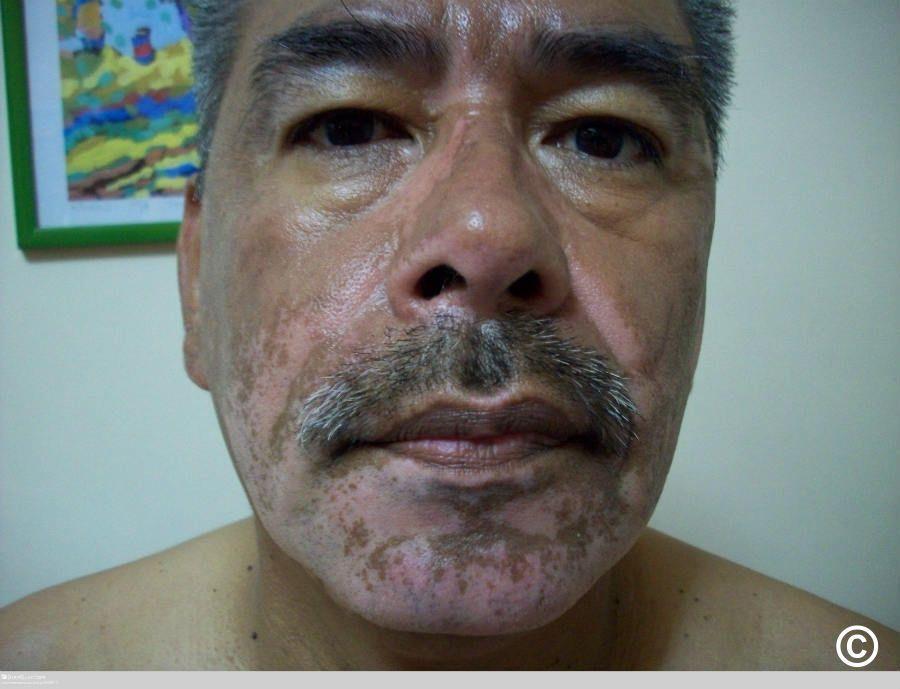

Vitiligo can develop at any age; it is rare to be present from birth. 50% of those affected develop vitiligo before the age of twenty.
The exact reason why vitiligo develops is not known. It is thought to be an autoimmune condition. The immune system, usually responsible for fighting infections, mistakenly fights against our own (hence, ‘auto’) cells that are responsible for pigmentation.
Up to one-third of people with vitiligo will have other family members affected, suggesting a genetic link. Vitiligo is more likely to develop in areas of the body subjected to friction and rubbing (such as in the groins or armpits), or arise where there is persistent scratching, burn injuries, or in surgical scars. This is called the Koebner phenomenon.
Vitiligo can follow a slow and progressive course or may wax and wane. There is a small chance of your skin colour returning to normal by itself.
Pigmentation in skin has an important role in protecting the skin from ultraviolet rays, which are a part of sunlight. Too much exposure to ultraviolet rays, from either natural sunlight, or using tanning salon sunbeds, increases the risk of skin cancer. Loss of protective pigmentation may, in theory, increase these risks. To avoid this, it is important to avoid excessive sun exposure and protect yourself from sunburn; if you are at risk of burning, wear a broad-spectrum sunscreen (SPF50 or greater, and 4-star or greater) applied all over the body, including on vitiligo and normal skin. Do not use tanning salons to get a tan.
Some people may wish to consider cosmetic camouflage. This is used to conceal, or lessen, the appearance of vitiligo. In most areas around the country, this is provided free by Changing Faces, a national charity. Some hospital departments may offer this service too.
Although there is no cure for vitiligo, if you need help there are various treatments that can be prescribed.
Treatment options provided by a health professional include anti-inflammatory creams and ointments (topical steroids and/or calcineurin inhibitors applied directly to the skin) and oral steroids (steroid medicines taken by mouth) for rapidly progressing colour loss.
Vitiligo can be associated (but not cause nor be caused by) other conditions caused by autoimmunity. Your healthcare professional may test for these if you have suggestive symptoms.
Reducing the amount of sunlight exposure may lower your vitamin D levels; your health professional may check your vitamin D levels and advise on supplementation.
Vitiligo can have a significant psychological impact. If your mental health is being affected, you should discuss this with a heath professional.
The following groups of people may need to be referred to a specialist, who will be either a Dermatologist or a GPwER/GPwSI in Dermatology (a GP who has been trained in relevant areas of dermatology):
The appointment may be face-to-face (the person attends the clinics), or a video call (Teledermatology).
Treatments offered in hospital include phototherapy (treatment by light) and tablets. These treatments work by affecting the immune system. In this way, the vitiligo may lessen and improve; however, as of yet, no treatment reliably cures or reverses vitiligo. Not all treatments are suitable for all patients; for example, phototherapy may need to be given 2 or 3 times a week, for 6-12 months, before a positive effect is seen. Immune-suppressing medicines carry important risks.
Only a minority of patients have a good response to treatment, even then there is a risk that once treatment is finished the vitiligo will return. Your health care professional will discuss the balance of risks and benefits and chances of any treatment being successful.
If you, a family member, or friend have an undiagnosed skin condition; or you want to learn more about how to treat skin conditions, please view our short video on how to get the best from this website.
Disclaimer - the author PCDS cannot accept responsibility for any misleading or incorrect statements, and the management of individual patients remains the direct responsibility of the individual doctor. We do however hope that visitors to this site can contact us regarding comments that are considered misleading or incorrect so that we can continue to improve the site.
Image Rights - The PCDS would like to thank Dermatoweb, DermQuest (Galderma), and others who have contributed images. All named individuals and organisations maintain copyright for the relevant images.
The following pharmaceutical companies have had no involvement in the content of this website or in our conference programmes