
LAST UPDATED: Jan 31, 2025

https://www.pcds.org.uk/patient-info-leaflets/eczema-gravitational-eczema
Gravitational eczema, also known as venous, varicose, or stasis eczema, is the name given to a type of eczema on the lower legs. The word eczema (or dermatitis) refers to a common inflammatory skin condition.
Features of gravitational eczema include any of the following:
Gravitational eczema is sometimes incorrectly diagnosed as cellulitis (a skin infection) and treated incorrectly with long courses of antibiotics. Cellulitis is nearly always unilateral (affecting only one leg) and causes a painful/tender spreading red area (or darker patch in skin of colour). People with cellulitis soon feel unwell and develop a temperature. If you think you have cellulitis you must seek urgent medical treatment. For more information refer to this link on cellulitis.

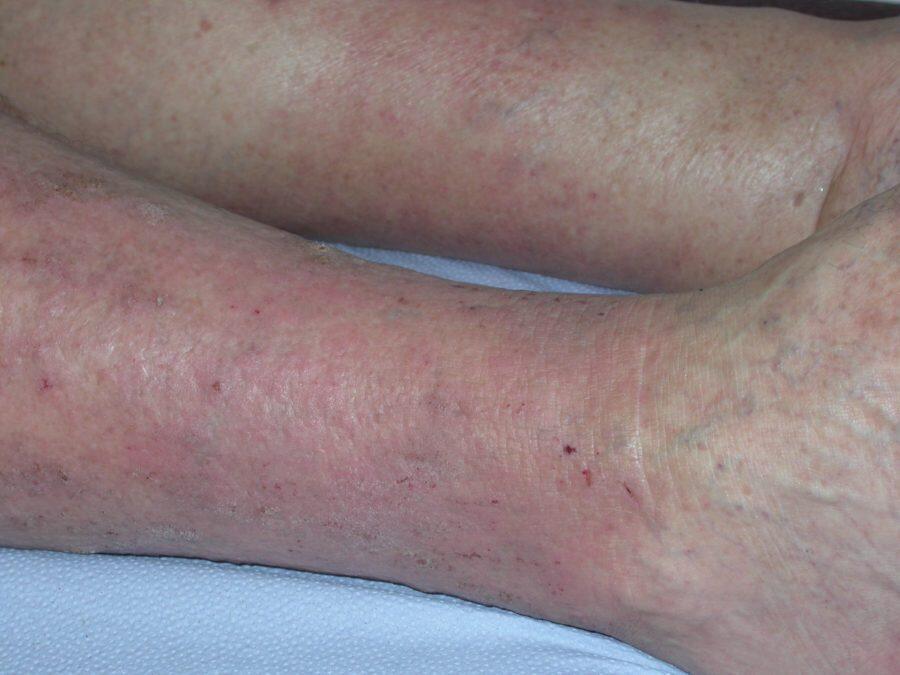

When small valves in the leg veins stop working properly it becomes difficult for blood to be pushed upwards against gravity and it can leak backwards. This increases pressure in the veins, forcing fluid out into the surrounding tissue, which then triggers inflammation and other features associated with gravitational eczema.
Factors associated with these changes include increasing age, gender (more common in women), obesity, pregnancy, immobility, previous blood clots in the leg (venous thrombosis) and previous cellulitis (skin infection).
The following steps may help reduce the symptoms of gravitational eczema and may help prevent other problems sometimes associated with gravitational eczema.
If your eczema is not responding to the measures described above, then make an appointment to see a health professional.
This link provides details on specific treatments.
General notes
on treatment:
The following groups of people may need to be referred to a specialist, who will be either a Dermatologist or a GPwER/GPwSI in Dermatology (a GP who has been trained in relevant areas of dermatology):
The appointment may be face-to-face (the person attends the clinics), or a video call (Teledermatology).
Unfortunately, the problem of the valves in the veins not working properly cannot be cured; this means that the management of gravitational eczema is long-term.
In persistent and very troubling cases of gravitational eczema, the opinion of a vascular surgeon may be sought to assess whether a varicose vein operation may be helpful.
Medical compression stockings are specially designed to steadily squeeze the muscles in your legs. They are tightest at the ankle and get gradually looser as they go further up your leg, helping improve the blood flow out of your veins towards your heart.
Choice of compression stockings
Compression stockings are available in different sizes and pressures. They are also available in:
Support stockings or tights that lightly compress the legs can be bought from pharmacies, however, compression stockings are more effective but are only available on prescription and require you to be measured by a health professional first.
Support / compressions stockings are not safe to wear if you have arterial disease in which not enough blood flows down your legs in your arteries - your nurse may need to do a blood pressure test known as the ankle brachial pressure index (ABPI) to check the blood flow in the legs before compression stockings can be prescribed.
Wearing compression stockings
You will usually need to put on your compression stockings as soon as you get up in the morning and take them off when you go to bed.
Wearing compression stockings can be uncomfortable, particularly during hot weather, but it is important to wear them correctly to get the most benefit.
Pull them all the way up so the correct level of compression is applied to each part of your leg. Do not let the stocking roll down, or it may dig into your skin in a tight band around your leg.
Speak to a health professional if the stockings are uncomfortable, they do not seem to fit, or you have difficulty putting them on. It may be possible to get custom-made stockings that will fit you exactly.
Take care when putting compression stockings on and taking them off, as this can damage fragile skin. If you have a leg ulcer, it ideally needs to heal before you start wearing compression stockings.
Caring for compression stockings
Compression stockings usually need replacing every 3-6 months, or sooner if they get damaged.
You should be prescribed 2 stockings (or 2 sets of stockings if you are wearing 1 on each leg) so that 1 pair can be worn while the other is being washed and dried. Compression stockings should be hand-washed in warm water and dried away from direct heat.
Not all people manage / tolerate compression stockings - some find it too difficult to put them on (e.g. if you have arthritis), others may find them too uncomfortable. If you notice that the skin is starting to break down or ulcerate you must stop wearing stockings and inform your health professional immediately as this may suggest that the stockings are preventing enough blood flowing down the legs.
This leaflet mentions ‘emollients’ (moisturisers). When emollient products come into contact with dressings, clothing, bed linen or hair, there is a danger that a naked flame or cigarette smoking could cause these to catch fire. To reduce the fire risk, patients using skincare or haircare products are advised to be incredibly careful near naked flames to reduce the risk of clothing, hair or bedding catching fire. Cigarette smoking (and being close to people who are smoking) should be avoided.
If you, a family member, or friend have an undiagnosed skin condition; or you want to learn more about how to treat skin conditions, please view our short video on how to get the best from this website.
Disclaimer - the author PCDS cannot accept responsibility for any misleading or incorrect statements, and the management of individual patients remains the direct responsibility of the individual doctor. We do however hope that visitors to this site can contact us regarding comments that are considered misleading or incorrect so that we can continue to improve the site.
Image Rights - The PCDS would like to thank Dermatoweb, DermQuest (Galderma), and others who have contributed images. All named individuals and organisations maintain copyright for the relevant images.
The following pharmaceutical companies have had no involvement in the content of this website or in our conference programmes